2026.08.18 AI News Briefing — Nvidia's $105 billion bet, a watershed in the AI infrastructure war
Contents
Nvidia's $105 billion bet, a watershed in the AI infrastructure war
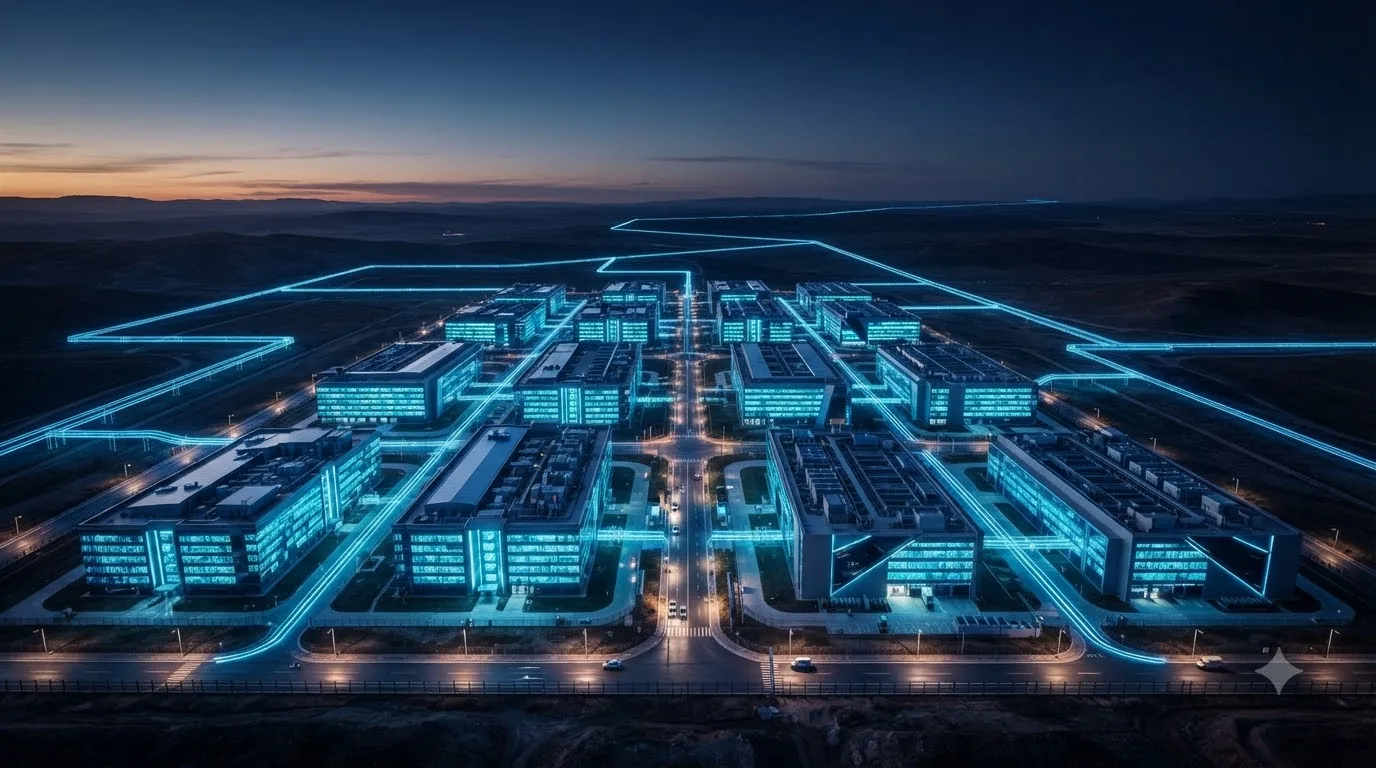
Nvidia is putting up to $105 billion into OpenAI's Ohio data center. The center of gravity in the AI race has shifted entirely from model performance to 'power and capital'. In Korea, Samsung, SK, and Naver are speeding up their AI hub plans in partnership with global Big Tech.
1. Nvidia to invest up to $105 billion in OpenAI's Ohio data center
- Source: Bloomberg | 2026.08.17 | https://www.bloomberg.com/news/articles/2026-08-17/nvidia-to-invest-up-to-105-billion-for-openai-data-center-in-ohio
- What happened: According to Bloomberg, Nvidia has agreed to invest up to $105 billion in a large data center campus in Pike County, Ohio, which OpenAI plans to lease. OpenAI will secure roughly 8 gigawatts (GW) of computing capacity at the site, with the first 800 megawatts targeted to come online in 2028. The $250 billion guarantee structure discussed earlier is reported to have been scaled back over investors' risk concerns.
- Why it matters: A structure in which the chip supplier underwrites even its customer's infrastructure financing revives the AI industry's peculiar 'circular investment' controversy. It is a symbolic deal for an era in which securing physical power and land has become AI competitiveness itself.
2. Anthropic expands gigawatt-scale compute partnership with Google and Broadcom
- Source: Anthropic Newsroom | 2026.08 | https://www.anthropic.com/news/google-broadcom-partnership-compute
- What happened: Anthropic announced it is expanding its partnership with Google and Broadcom to secure next-generation computing resources. Most of the facilities will be located in the US, extending the $50 billion US computing infrastructure investment plan announced in November 2025. Enterprise demand for Claude is growing fast: run-rate revenue has reportedly passed $30 billion, and the number of enterprise customers spending more than $1 million a year has topped 1,000.
- Why it matters: It signals that the TPU and custom ASIC path, breaking away from an Nvidia-GPU-only world, is starting to be used for real large-scale training.
3. xAI releases Grok 4.6 — context window expanded to 500,000 tokens
- Source: AI industry roundup | 2026.08.12 | https://aitoolsrecap.com/Blog/AINewsAugust2026.aspx
- What happened: xAI released Grok 4.6. It is rated on par with the top-tier models on industry benchmarks, and its context window (the amount of text it can handle at once) has been expanded to 500,000 tokens. Pricing is reported at around $2 per million input tokens and $6 per million output tokens.
- Why it matters: As the performance gap narrows, the axis of frontier model competition is shifting from 'how smart' to 'how cheaply and how much context it can handle'.
4. OpenAI appoints Dali Rajic as new Chief Revenue Officer (CRO)
- Source: Tech Startups | 2026.08.17 | https://techstartups.com/2026/08/17/top-tech-news-today-august-17-2026-ge-microsoft-nvidia-open-stripe-unitree-more/
- What happened: OpenAI is reported to have appointed Dali Rajic as Chief Revenue Officer on August 17, a hire read as a move to seriously scale its enterprise sales organization. In the same period, reports continued that Microsoft is wrestling with the physical limits of securing data center sites and power.
- Why it matters: It means the transition from a research-centered organization to a large-scale B2B sales organization is in full swing. Competition over enterprise AI adoption is expected to intensify.
5. AI data centers emerge as the power semiconductor industry's 'new growth engine'
- Source: ET News | 2026.08.07 | https://www.etnews.com/20260807000243
- What happened: According to ET News, AI data centers are emerging as a new growth axis for the power semiconductor industry. As AI accelerator performance rises, power consumption per server rack has surged, and the analysis is that the bottleneck has expanded beyond securing GPUs to power supply and conversion efficiency. Major companies such as Infineon and onsemi are expanding data center production capacity and pursuing long-term supply contracts with large customers. HBM4 is reported to consume about 20% less power than HBM3E while improving performance by 60%.
- Why it matters: As the 'AI = GPU' formula expands to 'AI = power infrastructure', SiC and GaN compound power semiconductors are emerging as a new investment theme.
6. Samsung, SK, and Naver in $950 billion of AI cooperation with global Big Tech
- Source: Newsis | 2026.07.25 | https://www.newsis.com/view/NISX20260725_0003723124
- What happened: Samsung Electronics, SK, and Naver are reported to be entering AI partnerships with global Big Tech worth a combined $950 billion. Samsung Electronics is pursuing advanced memory supply and AI chip foundry cooperation with Broadcom for 2026–2030, and Samsung SDS signed a partnership with Anthropic to train applied AI engineers. Naver is building a mega AI factory with Nvidia, targeting a first 55 MW phase in 2027.
- Why it matters: A real investment cycle has begun that will decide whether Korea can establish itself as an 'AI hub'.
7. Adobe Firefly unveils 'Run' beta for batch processing up to 500 assets
- Source: Adobe Help / Firefly release notes | 2026.08.08 | https://helpx.adobe.com/firefly/web/whats-new/new-features/whats-new.html
- What happened: In its August 8 Firefly update, Adobe unveiled 'Run' (beta), a batch job interface that processes up to 500 input assets at once. In June it had already extended creative agents across Creative Cloud, including Photoshop, Premiere, and InDesign. AEM Assets also offers a flow that generates assets directly in Firefly when a search returns no results.
- Why it matters (AEM and enterprise perspective): It is a turning point from individual generation to 'batch production'. From an enterprise DAM perspective, it means repetitive work such as generating hundreds of banner variations per campaign can be turned into a pipeline; at the same time, unless metadata, versioning, and permission management for generated assets are set up in advance, the DAM can quickly become polluted.
Today's insight
1. The decisive ground in the AI race has moved from 'models' to 'power and land'. The Nvidia–OpenAI Ohio deal, the Anthropic–Google–Broadcom partnership, and the Korean power semiconductor story all point the same way. The gigawatt (GW) is now the AI industry's new unit.
2. Model performance has leveled out; competition is now about price and context. As the Grok 4.6 case shows, with benchmark gaps between top models narrowing, token price and context length are becoming the practical selection criteria.
3. The financing structure deserves attention. Having the chip supplier guarantee its customers' data center financing accelerates growth, but if demand turns, the risk concentrates in one place. Nvidia scaling back the size of its guarantee reads in the same context.
Contents
Related posts
2026.08.12 AI News Briefing — AI security agents and a 550 trillion won AI data center push
OpenAI released a dedicated cybersecurity model, kicking the AI offense-versus-defense race into high gear. Google icon Jeff Dean is leaving after 27 years to found an AI research automation startup. In Korea, a 550 trillion won AI data center investment and a 'one AI agent per citizen' policy are gathering speed.
2026.05.11 AI News Briefing — Pentagon signs AI deals with 8 companies, leaving out only Anthropic; KOSPI breaks 7,000
The new week opened with the global AI power map dividing one step further. The US Department of Defense signed AI tool contracts with eight Big Tech firms including SpaceX and OpenAI at once, officially excluding Anthropic, and the list included dark-horse newcomer 'Reflection AI', founded by an AlphaGo co-developer. Meanwhile, Anthropic signed a compute token deal with SpaceX and launched AI agents for financial work. Colorado is on the verge of passing a bill that repeals and replaces its own AI Act, and in Korea the KOSPI crossed 7,000 for the first time ever on AI and semiconductor tailwinds.
2026.04.25 — Big Tech realignments and the agent era in full swing
Google is investing up to $40 billion in Anthropic, and Meta is cutting 8,000 jobs in the name of AI efficiency. China's DeepSeek has closed the frontier-model gap once again with V4. Today marks an inflection point where the race for AI infrastructure and the commercialization of agents accelerate at the same time.
2026.04.24 — Big Tech's 'AI arms race' shakes up jobs
Google pledged up to $40 billion to Anthropic, tightening the AI infrastructure alliance. The same day, Meta and Microsoft announced large layoffs and a voluntary retirement program, making it explicit that AI investment money is coming out of payroll. Today's takeaway: the AI infrastructure race is reshaping the labor market itself.