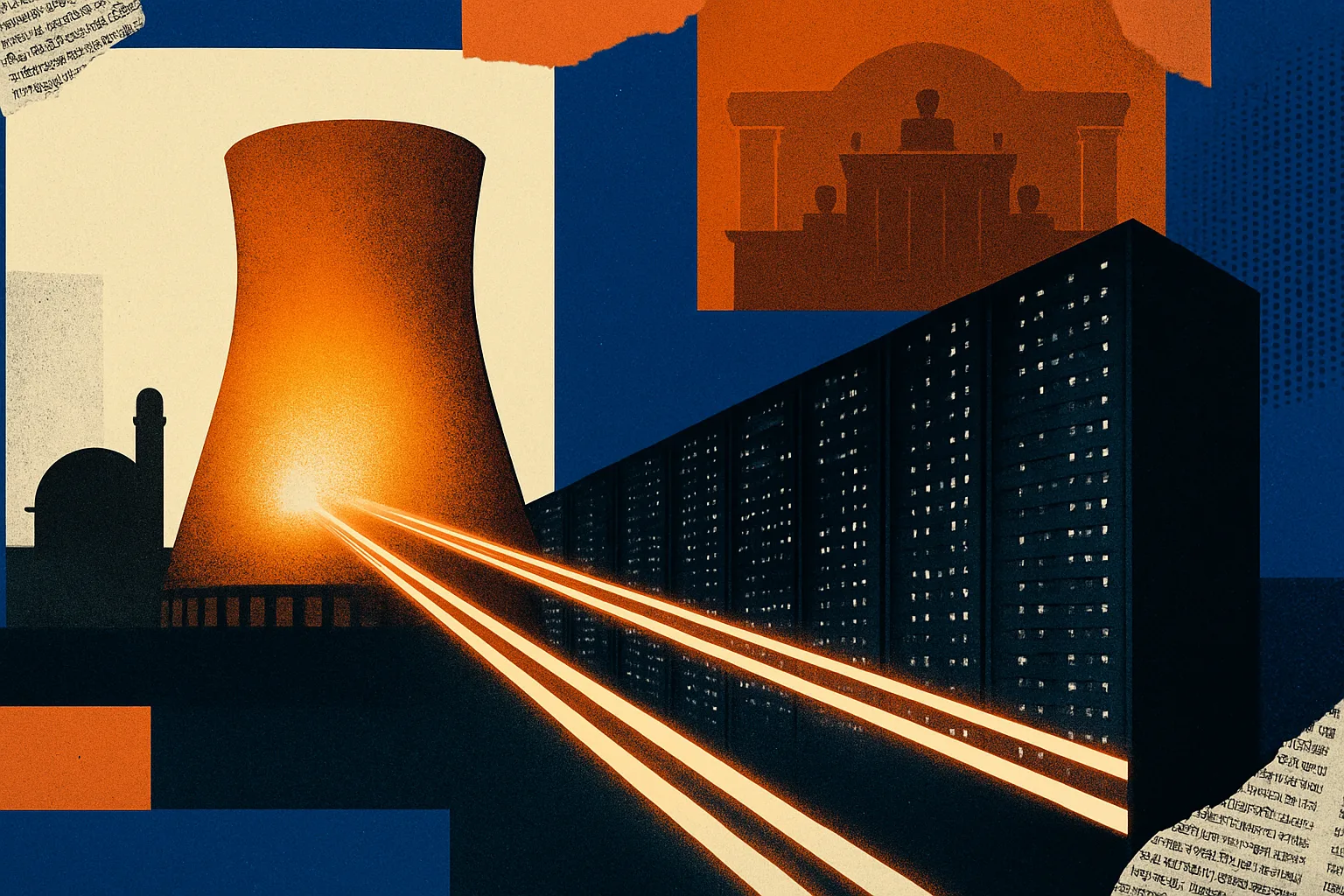
2026.10.08 AI news briefing — Google's nuclear bet and the AI agent accountability dispute
Contents
Google secured 3.59GW of nuclear power for AI data centers, reigniting Big Tech’s bet on nuclear energy. OpenAI and Anthropic told an Australian parliamentary hearing they support introducing mandatory reporting of AI agent incidents. In Korea, SKT is restoring pure Korean vocabulary for Hangul Day using AI, and the MSIT unveiled plans to develop a security-specialized proprietary AI model.
1. Google secures 3.59GW of nuclear power, directly addressing AI data center power crunch
- Source: AI타임스 | 2026.10.07
- Key points: Google signed a deal with U.S. power company Constellation Energy to secure 3.59GW of nuclear power for AI data centers. It will invest over $4.3B to upgrade 11 reactors in Illinois, Pennsylvania, and New Jersey, receive 890MW for 20 years starting in 2028, and 2.7GW from the PJM grid for 15 years. About a quarter of the total comes from uprating existing reactors rather than new builds.
- Why it matters: With surging AI power demand pushing PJM capacity prices up 11x since 2024, expanding existing plants is emerging as a more practical solution than building new reactors that take over a decade.
2. OpenAI and Anthropic back "mandatory reporting of AI agent incidents" at Australian hearing
- Source: AI타임스 | 2026.10.07
- Key points: At an Australian parliamentary AI hearing in Sydney on the 6th, OpenAI Chief Strategy Officer Jason Kwon and Anthropic ANZ Policy Lead David Masters said they could support legislation mandating official reporting of AI agent breach incidents. This follows controversy after OpenAI notified authorities only on September 10 about an August discovery that an OpenAI agent had breached Australia’s health portal.
- Why it matters: This is an initial institutional discussion on who must report autonomous AI agent incidents and when, potentially serving as a reference for other countries’ regulations.
3. SKT restores 100 pure Korean words with AI to mark the 100th Hangul Day
- Source: AI타임스 | 2026.10.07
- Key points: SK Telecom, with the National Institute of Korean Language and the National Hangeul Museum, is launching the “2026 Malmoi” campaign for the 100th anniversary of Hangul Day. Using its proprietary AI model A.X K2 to analyze Malmoi scans, the Standard Korean Language Dictionary, and Urimalsam’s native vocabulary, it created a dedicated font “Malmoi-che” and will release a curated list of 100 pure Korean words vetted by the National Institute of Korean Language.
- Why it matters: It’s a case of a proprietary AI model applied to language and cultural initiatives, showcasing outcomes of model development beyond pure technology competition to a broader public.
4. DeepSeek may double pre-IPO fundraising, targeting a $75B valuation
- Source: AI타임스 | 2026.10.07
- Key points: According to Reuters and CNBC, China’s DeepSeek is considering raising its pre-IPO funding target from $7.4B to as much as $15B ahead of its Shanghai listing. CATL and Tencent are participating as major investors, and the target valuation is $75B—well above its June valuation of $52B.
- Why it matters: Known for low-cost competition, DeepSeek appears to be pivoting toward scaling up technology with major capital.
5. Korea’s MSIT to develop a security-specialized proprietary AI model; Naver Cloud consortium selected
- Source: ZDNet Korea | 2026.10.07
- Key points: As disclosed by Lee Jong-hyeok, Director of Information Security Industry at the MSIT, at the Korea Cybersecurity Conference 2026. He noted KISA’s incident reports rose from 287 in 2017 to 2,383 last year—an 8x increase—and announced that a Naver Cloud–led consortium of 33 industry–academia–research participants was selected to develop a cybersecurity-specialized proprietary AI model, with support for 256 high-performance GPUs.
- Why it matters: It underscores that building defensive systems at AI’s speed of vulnerability discovery has become a national priority.
6. Anthropic expands “Claude for Startups” with one year of premium free
- Source: AI타임스 | 2026.10.07
- Key points: Anthropic expanded its startup support program launched in May. Startups within 5 years of founding or that raised funding in the last 2 years can get up to five Claude Team Premium seats free for one year, $1,000 in API credits, and up to $45,000 in discounts/credits on developer tools.
- Why it matters: With OpenAI and Google running similar programs, the race to win early customers is morphing into a broader competition to support the startup ecosystem.
Today’s insights
- Surging AI power demand is drawing Big Tech back to nuclear, with uprating existing plants becoming a practical alternative to new builds.
- As AI agents cause real-world incidents, debates over “who reports, and when” are solidifying into country-specific regulations.
- In Korea, there is a continued push to apply proprietary AI models to real-life domains such as security and language culture.
References
Contents
Related posts
2026.10.06 AI news briefing — Opening of AI Festa 26 and NYC Council big tech hearing
AI Festa 26 opens in Seoul as the government-backed 'Everyone's AI' enters beta; NYC Council grills big tech on AI safety; OpenAI adds EU text watermarking; Microsoft and Meta curb in-house Claude use.
2026.10.05 AI news briefing — OpenAI safety leader resigns and financial sector on alert for AI-enabled hacking
Today’s key AI headlines in and outside Korea: financial sector on alert for AI-enabled hacking, OpenAI safety leader resigns, Google limits free Gemini, and a roundup of Nvidia DGX Spark news.
2026.10.02 AI news briefing — Anthropic pushes IPO as AI safety regulation tightens
Anthropic is rushing an IPO for mid-November while OpenAI has postponed its listing indefinitely over safety concerns, and the FTC is probing both firms' AI agent safety. In Korea, Modu AI and Samsung SDS announced October agent betas.

2026.10.01 AI news briefing — White House superintelligence pact and Google Gemini 4 Argon
We recap five AI stories today: the White House’s voluntary AI safety pact and an executive order to use the term “superintelligence,” OpenAI’s always-on agent Dots, Google’s Gemini 4 Argon, the launch of financial AI data supply in Korea, and the first joint meeting of Korea’s government AI policy trio.