55% of companies that carried out AI-based layoffs regret it — the trap of the AI-First strategy
Contents
55% of companies that carried out AI-based layoffs regret it — the trap of the AI-First strategy
The expectation was that replacing employees with AI would cut costs and boost efficiency. Yet according to a Forrester survey, 55% of companies that carried out AI-based layoffs regret the decision. Through real cases at Klarna, IBM, McDonald's, and others, we analyze why the 'AI-First strategy' turned into a trap.
At a glance
| Item | Details |
|---|---|
| Topic | Regret and rehiring after AI-based workforce cuts |
| Key data | 55% of companies that carried out AI layoffs regret it (Orgvue, Forrester, 2025) |
| Key case companies | Klarna, IBM, McDonald's, Amazon, Block, Chegg |
| Related forecast | 50% of companies that laid off staff for AI will rehire by 2027 (Gartner, 2026) |
| Key lesson | AI should be approached as an 'augmentation' tool, not a 'replacement' |
Background — what is happening?
Since ChatGPT arrived in 2023, companies around the world have rushed to adopt AI and cut staff. In 2025 alone, about 55,000 US jobs were eliminated with AI cited as the reason, and more than 30,000 AI-based layoffs have already been announced in 2026. (Challenger, Gray & Christmas, 2025)
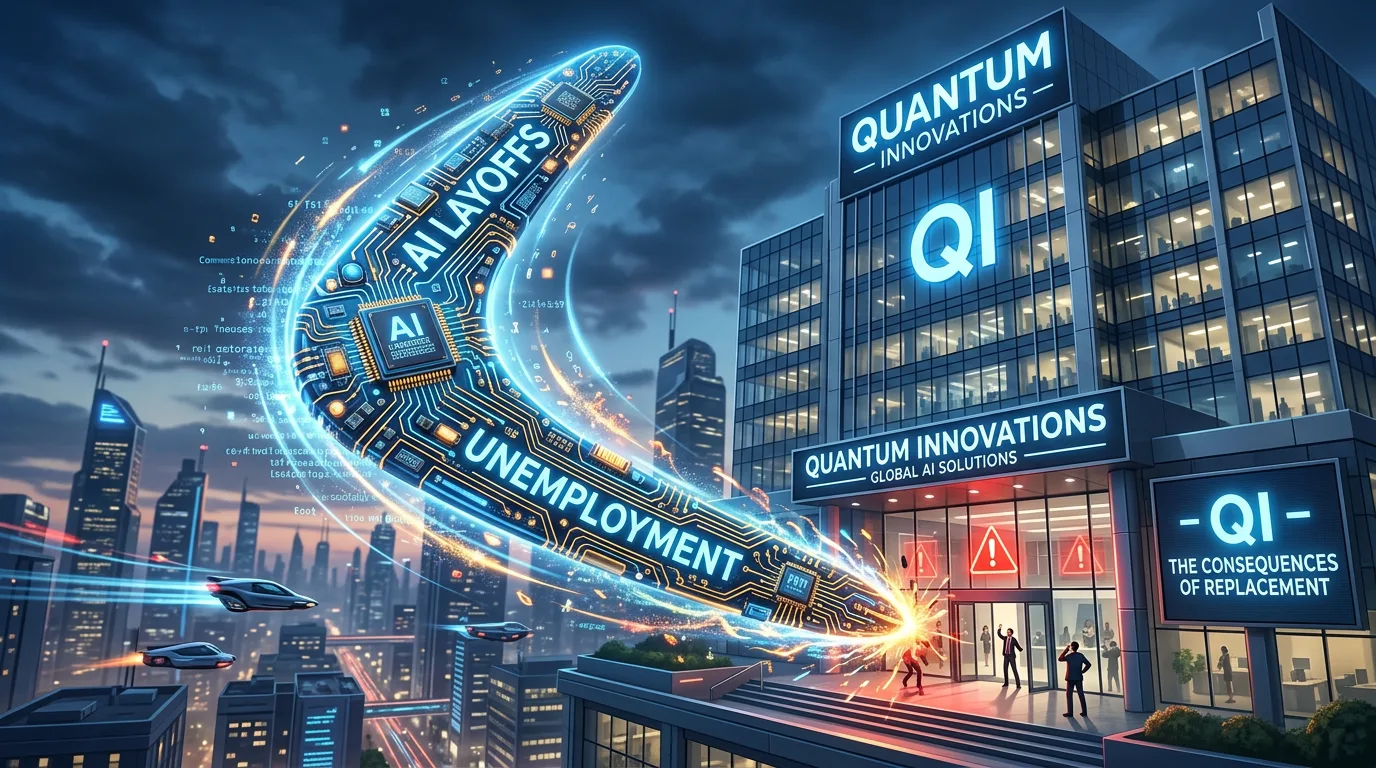
But from late 2025, an unexpected phenomenon began to appear. Researchers call it the 'Layoff Boomerang': companies that replaced employees with AI run into falling service quality, customer churn, and loss of institutional knowledge, and end up hiring humans again.
This is not just anecdote. Data from major institutions including Gartner, Forrester, IBM, and Harvard Business Review consistently point to the same conclusion.
Key data — where does the 55% come from?
The figure has two original sources.
First, a survey by workforce planning software company Orgvue, which polled 1,163 C-suite and senior decision makers across eight countries including the US, UK, and Australia. In it, 39% of companies said they had cut staff because of AI adoption, and of those, 55% said they regret the decision. It also found that at 34% of companies, AI adoption itself caused employees to leave voluntarily. (Orgvue, 2025)
Second, Forrester Research's 'Predictions 2026: The Future of Work' report reconfirmed the figure. Forrester noted that 'companies are carrying out layoffs by betting on AI capabilities that do not yet exist', and predicted that half of AI layoffs would be quietly reversed. (Forrester, October 2025)
Gartner likewise predicted in a report published in February 2026 that by 2027, 50% of companies that cut staff for AI will rehire for similar roles. (Gartner, February 2026)
Real cases — which companies regretted it, and why
Case 1. Klarna — rehiring after declaring it had 'replaced 700 people'
Swedish fintech Klarna is the most emblematic case of the AI-First strategy. In February 2024 it rolled out an OpenAI-based chatbot and announced that 'AI is doing the work of 700 full-time agents'. It expected to handle 2.3 million conversations a month, cut response time from 11 minutes to 2, and save $40 million a year. (Klarna official press release, February 2024)
But in May 2025, CEO Sebastian Siemiatkowski publicly admitted in a Bloomberg interview that 'cost unfortunately seems to have been a too predominant evaluation factor, and what you end up having is lower quality'. Customers complained of robotic responses, an inability to handle complex problems, and being asked to repeat the same explanation. Klarna began rehiring 'Uber-style' freelance customer service agents. (Bloomberg, Fortune, May 2025)
Forrester vice president Kate Leggett said Klarna 'focused too much on cost cutting without thinking about customer experience', suggesting it may have been managing cost-cutting optics timed to the IPO. (CX Dive, November 2025)
Case 2. IBM — headcount actually grew after cutting 8,000
In 2023, IBM cut about 8,000 jobs, mainly in HR, and automated repetitive work with the AI chatbot 'AskHR'. AskHR handled more than 11.5 million internal requests in 2024 and succeeded in automating 94% of HR tasks. Internal customer satisfaction (NPS) also improved dramatically, from -35 to +74. (IBM official materials, 2024)
But on the remaining 6% of requests, sensitive workplace issues, ethical dilemmas, and cases requiring emotional counseling, the AI showed its limits. Side effects such as delayed problem resolution and lower employee morale appeared. (HRKatha, May 2025)
As a result, IBM started rehiring. The interesting point is that by reinvesting the resources saved through HR automation into high-value roles in engineering, sales, and marketing, total headcount actually increased. CEO Arvind Krishna explained that 'thanks to AI, we can invest more in areas that require human creativity and interaction'. IBM's total headcount is now more than 270,000. (WSJ, 2024)
Case 3. McDonald's — pulls AI drive-thru after a three-year test
From 2021, McDonald's partnered with IBM to test an AI voice ordering system (Automated Order Taker) at more than 100 US restaurants. But the AI failed to properly recognize customers' varied accents, dialects, and background noise. (CNBC, June 2024)
Order accuracy stalled in the mid-80% range, and franchisees complained that technology updates were slow and not worth the cost. Episodes went viral on TikTok, such as a customer ordering a caramel ice cream and getting butter piled on, or hundreds of dollars of chicken nuggets added to an order, damaging the brand image as well. (Museum of Failure, 2025)
In July 2024, McDonald's ended the three-year test and removed the AI ordering system from all restaurants. It did say it would continue to explore AI ordering technology with other partners such as Google. (Restaurant Business, June 2024)
Case 4. Amazon — 30,000 layoffs, but 'continuing to hire in core areas'
Amazon cut about 30,000 corporate employees across October 2025 and January 2026. It cited AI investment as the basis for the cuts, but the internal memo carried the caveat that 'we will continue to hire in core strategic areas'. (Programs.com, 2026)
In fact, Amazon's job postings hit a record 496,000 in the second half of 2025, then plunged to 70,700 in Q1 2026 after the layoff announcement, a dramatic swing. This suggests it was an abrupt restructuring driven by management decisions rather than AI gradually replacing workers. (JobsPikr, March 2026)
Case 5. Block (Square) — half the workforce cut
Block (formerly Square) CEO Jack Dorsey cut about 4,000 jobs in February 2026, reducing headcount from 10,000 to under 6,000. In a shareholder letter he said 'intelligent tools have changed what it means to build and run a company'. Block's job postings showed the same pattern: a surge in the second half of 2025 followed by a 91.3% plunge in Q1 2026. (Programs.com, 2026)
Case 6. Chegg — not 'replaced' by AI, but its business itself eroded
Education tech company Chegg cut 45% of its workforce (about 388 people) in October 2025. This case differs in nature from the ones above, however. Chegg did not replace employees with its own AI; rather, its student customers were lost to external AI tools such as ChatGPT and the business itself shrank. It shows that AI affects companies not only 'from inside' but can dismantle the business model 'from outside'. (Programs.com, 2025)
Why the regret — common patterns
Taken together, the cases reveal common patterns among companies that regret AI-based layoffs.
First, the layoffs were bets on 'future AI capabilities'. In a Harvard Business Review survey of more than 1,000 global executives, most AI-based layoffs were based not on currently proven AI performance but on capabilities expected to become possible in the future. More than 600 executives admitted they decided on cuts based on the expectation that 'AI will be able to do it someday'. (HBR, December 2025)
Second, the ROI achievement rate of AI projects is itself low. IBM's survey of 2,000 CEOs found that only one in four AI projects achieved the expected ROI, and only 16% had been scaled across the enterprise. Even so, 64% of CEOs said they 'invest before fully understanding the value out of fear of falling behind'. (IBM CEO Study, 2025)
Third, rehiring costs offset the savings. In a February 2026 Careerminds survey of 600 HR professionals, 35.6% of companies that rehired after AI layoffs brought back more than half of the people they had let go. A third of those said rehiring cost more than the original savings. (Careerminds, February 2026)
Fourth, the morale of remaining employees suffers badly. Forrester named this the 'Coasters' phenomenon: employees who watch colleagues laid off because of AI lose motivation and do only the minimum. This group was 27% in 2024 and 25% in 2025, and is projected to rise to 28% in 2026. When a quarter of the workforce is actively withholding effort, no AI, however good, can make up the lost productivity. (Forrester, 2025)
So how are the successful companies different?
Not every AI adoption failed. According to PwC's 2025 Global AI Jobs Barometer, in industries with high AI exposure, revenue growth per employee was three times higher than in non-exposed industries . But the companies that achieved this did not lay off employees; they used AI in ways that raised employee productivity. (PwC, June 2025)
The IBM case can ultimately be seen as a success story too. After automating repetitive HR work, it reinvested the savings in high-value roles such as engineering and sales, and total headcount actually grew.
The key difference is this: failed companies saw AI as a 'labor cost reduction tool', while successful companies used AI as a 'lever for workforce redeployment'.
Applying it to your organization
1. Ask 'what is the purpose of this role' before 'can AI replace it'. As the Klarna case shows, the 'tasks' of customer service could be automated, but its 'purpose', building trust and solving problems, could not. Before deciding on cuts, the first step is to distinguish whether the role is a 'task' or a 'purpose'.
2. Adjust headcount after AI capability is 'proven'. As the HBR survey revealed, most AI layoffs were bets on future possibilities. It is not too late to adjust the workforce structure after adopting AI and measuring actual results for at least six months.
3. Reinvest the savings in high-value areas. IBM's success came from reinvesting the costs saved through HR automation into engineering, sales, and marketing. Reframing the goal of AI adoption from 'cost reduction' to 'capability redeployment' lets you raise productivity without layoffs.
4. Invest in AI training for remaining employees. According to Forrester, only 23% of companies provide AI training (such as prompt engineering). Raising employees' AI skills is more cost-effective than layoffs and also prevents the 'coasters' phenomenon.