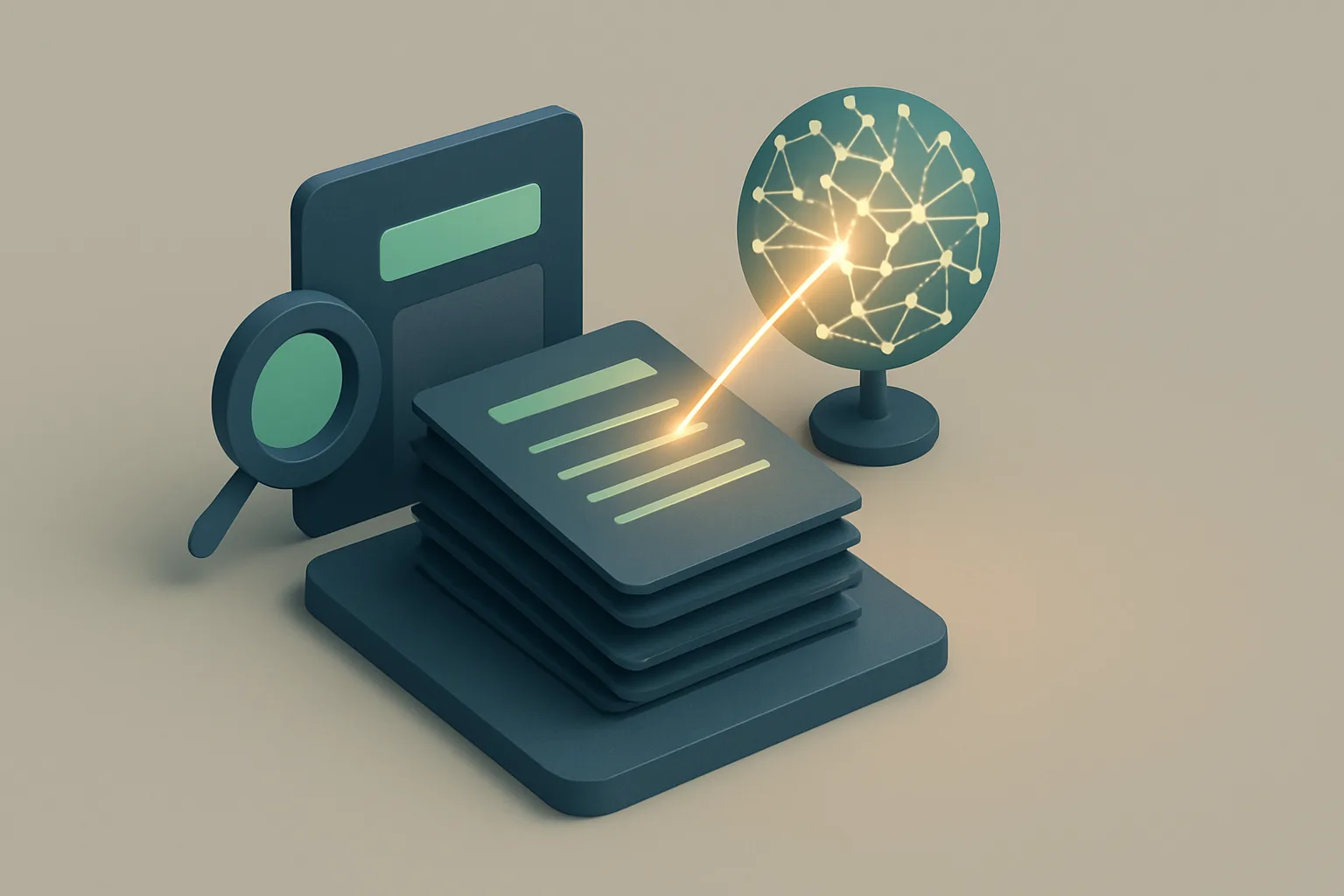
RAG — How to keep models up to date without fine-tuning
Contents
If you mistake RAG for “teaching documents to the model,” you’ll end up disappointed when the model doesn’t permanently remember whatever you stuff into a vector database. RAG is a retrieval procedure that, instead of training, looks up relevant materials for each incoming question and inserts them into the prompt. If you miss this distinction, it’s hard to understand why the model sometimes overlooks the latest information or cites unrelated documents.
Background / why this term now
The name RAG (Retrieval-Augmented Generation) was first proposed in a 2020 paper by Patrick Lewis et al. At the time, researchers from Facebook AI Research (now Meta AI), UCL, and NYU presented at NeurIPS 2020, defining RAG as “a general framework for fine-tuning that combines a pre-trained parametric language model with a non-parametric retriever over an external knowledge corpus” (arXiv: https://arxiv.org/pdf/2005.11401).
As of 2026, many frontier-level models support context windows around 1 million tokens, reviving the question, “Can’t we just stuff whole documents in without RAG?” (Winder.ai: https://winder.ai/rag-vs-fine-tuning-2026-decision-framework/). Even so, most real-world LLM applications still adopt RAG as the default architecture, which is why it’s worth clarifying exactly what RAG is and when it’s useful.
Key data and current status
| Metric | Details | Source |
|---|---|---|
| First proposal | NeurIPS 2020, Lewis et al. (Facebook AI Research · UCL · NYU) | Lewis et al., "Retrieval-Augmented Generation for Knowledge-Intensive NLP Tasks" |
| Expanding context windows | In 2026, many frontier and mid-tier models support ~1–2 million tokens; prompt caching reduces reuse cost | Winder.ai, 2026.06.24 |
| Build cost/time by approach (2026) | RAG about 5k–40k pounds · 1–3 weeks / fine-tuning about 10k–60k pounds · 4–8 weeks / hybrid about 30k–120k pounds · 6–12 weeks | Winder.ai, 2026.06.24 |
| Fine-tuning data requirements | Old rule of thumb “at least 1,000 examples” → In 2026, with LoRA, 200–500 curated examples can suffice | Winder.ai, 2026.06.24 |
Interpretation: Larger context windows don’t eliminate RAG. They mainly make “long-context only” competitive in the narrow case where your corpus is smaller than the window and rarely changes.
Deep dive
1) What exactly is RAG?
RAG has two stages. First, it converts the user’s question into an embedding (a numeric vector representation of the text) and compares it against document embeddings stored in a pre-built vector database to retrieve the most similar chunks (top-k) (Retrieval). Then it inserts those chunks into the prompt alongside the original question so the language model can produce an answer (Generation) (NVIDIA Blog: https://blogs.nvidia.com/blog/what-is-retrieval-augmented-generation/). The model’s weights never change; on every request you fetch “the materials needed for this question” and place them next to it.
2) Common misconceptions — and why they happen
The most common misconception is “RAG = model training.” Because the act of loading documents into a vector DB is often described as “teaching the AI,” people assume the model’s parameters are updated. In reality, you’re building a search index, not changing weights. The second misconception is that “RAG eliminates hallucinations” (hallucination: plausible but incorrect outputs). Wikipedia is clear that “models can still hallucinate even around retrieved passages” (Wikipedia: https://en.wikipedia.org/wiki/Retrieval-augmented_generation). If a retrieved document is wrong, or retrieved documents conflict, the model may fail to determine which one is correct.
3) How to actually decide
Choosing among RAG, fine-tuning, and long context is easiest if you ask “what changes?” Retrieval selects evidence at request time; fine-tuning changes the model’s behavior from examples; long context simply feeds more material in a single request (Winder.ai: https://winder.ai/rag-vs-fine-tuning-2026-decision-framework/). If knowledge updates frequently, citations are required, or your corpus exceeds the context window, RAG is advantageous. If the model already knows the facts and you only want to change style, tone, or structure, fine-tuning is the better fit.
4) When it helps and when it’s pointless
If your corpus is small (fits within the context window) and rarely changes, leveraging prompt caching to include full documents each time can be simpler than building a separate retrieval pipeline. By contrast, when access must be controlled per document, data updates daily, or total volume exceeds the window—as in internal knowledge-base services—there’s no sharp alternative to RAG yet.
In practice — 4 principles for reading RAG correctly
- “Adopting RAG” does not mean “zero hallucinations.” If retrieved documents are wrong or outdated, the model will simply rephrase those errors convincingly.
- Start by sizing corpus volume and update frequency. For small, static material, long context without a vector DB can be cheaper.
- The more your domain requires citations (law, internal policies, customer support justifications), the more RAG pays off—you can trace answers back to their sources.
- RAG and fine-tuning aren’t mutually exclusive. As of 2026, a hybrid is common in practice: use RAG for what to answer, and fine-tuning for how to answer.
References
Contents
Related posts
RAG — how to know the latest information without fine-tuning
RAG retrieves relevant documents at query time and inserts them into the prompt instead of retraining the model. It’s often better than fine-tuning for fast-changing knowledge or citation needs, but it doesn’t eliminate hallucinations.
Fine-tuning — the misconception that you can teach your company to AI
If you mistake fine-tuning for "teaching AI your company’s entire knowledge," you’ll pay the cost and end up with a model that can’t reflect fresh info. Here’s how LoRA works and when to try RAG or prompt engineering first.
What is AI hallucination?
Hallucination is not the result of AI 'breaking'. It is closer to a structural side effect: today's training and evaluation methods award more points for a plausible guess than for saying 'I don't know'. Once you understand the mechanism, the way you deal with it changes too.
Training vs. Inference — When Does AI Actually Get Smarter?
It feels like AI gets smarter the more you talk to it, but it does not actually learn anything new mid-conversation. This article lays out how training and inference differ, and why test-time compute became the AI industry's new buzzword in 2026, with data.