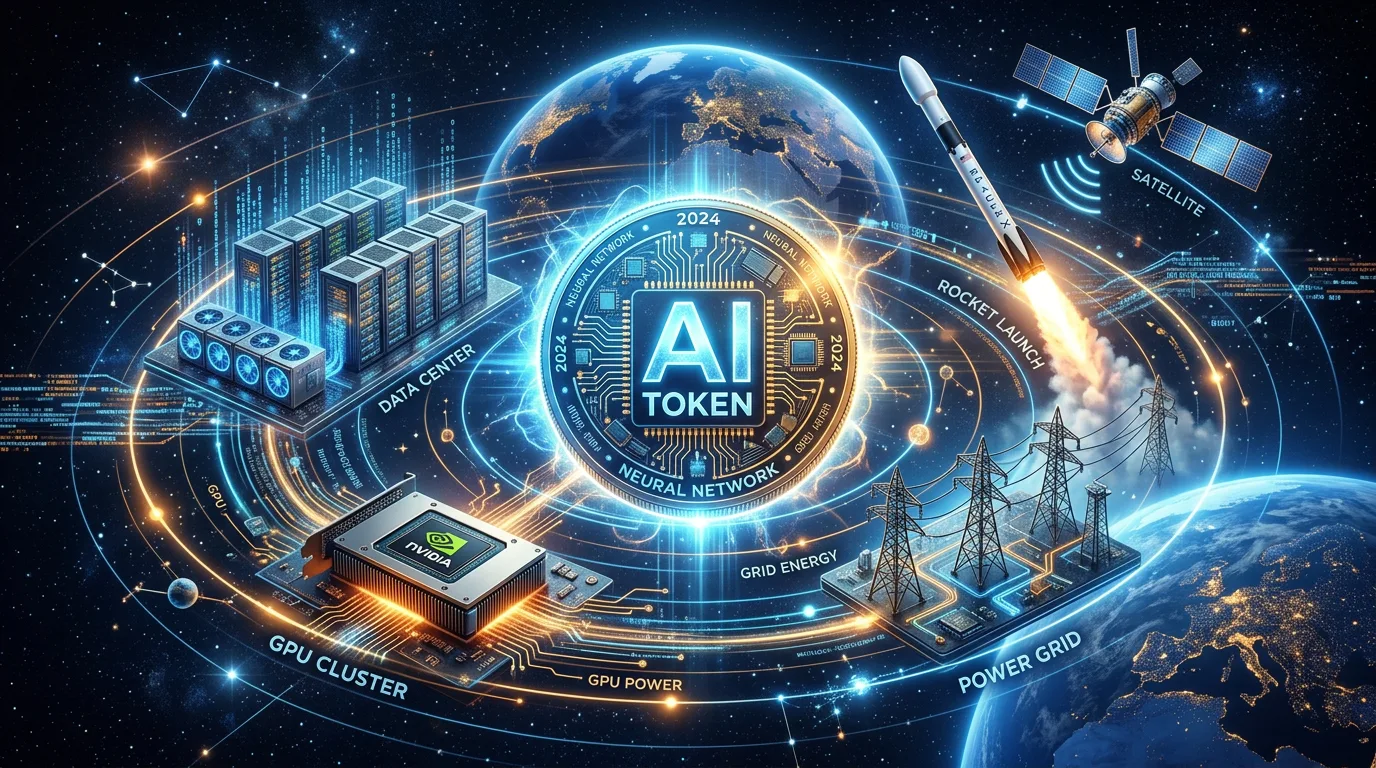
The real front line of the 2026 AI industry isn't models — the rise of the 'token economy' and a three-axis strategy for Korean companies
Contents
The real front line of the 2026 AI industry isn't models — the rise of the 'token economy' and a three-axis strategy for Korean companies
In 2026, the AI industry is no longer decided by 'which model is smarter'. The Anthropic–SpaceX compute deal, the Pentagon's selection of eight AI vendors, and Goldman Sachs' $7.6 trillion forecast all point one way — the true opening of an 'AI compute economy' in which tokens are the new currency. Korean companies must immediately realign around a three-axis strategy that binds 'token cost, power and chip supply, and use policy', beyond comparing model performance.
Background / why this topic now
In the first week of May 2026, a cluster of events broke at once that decisively shifted the center of gravity of the global AI industry.
May 1 The US Department of Defense simultaneously signed classified-network AI contracts with eight companies: SpaceX, OpenAI, Google, Microsoft, NVIDIA, AWS, Oracle, and Reflection. May 6 Anthropic announced a surprise deal to lease the entire compute of SpaceX's Colossus 1 data center (220,000 NVIDIA GPUs, 300 MW), and at the same event the two companies formalized their intent to cooperate on 'orbital data centers' (SpaceX official blog, 2026.05.06). May 8 Semafor summed it up: 'AI tokens have begun to eat the economy'.
In the same period, Anthropic's quarterly revenue grew about 80-fold to an annualized run rate of about $30 billion, overtaking OpenAI (about $24 billion) (VentureBeat, 2026.05.08), and Goldman Sachs forecast that about $7.6 trillion of capital will flow into compute, data center, and power infrastructure over the six years from 2026 to 2031 (cited by Semafor, 2026.04).
In short, the arc is this: model race (2023–2024) → infrastructure race (2025) → token economy (2026–).
The first week of May 2026 is likely to be recorded as the turning point of this transition.
Key data and current state
- Anthropic quarterly revenue growth: About 80x (announced by CEO Dario Amodei, VentureBeat, 2026.05.08)
- Anthropic annualized revenue (ARR): About $30 billion (from about $9 billion to about $30 billion in four months, 2026.04–05)
- Anthropic–SpaceX compute deal: 300 MW · 220,000 NVIDIA GPUs, using the entire Colossus 1 data center (Bloomberg/CNBC, 2026.05.06)
- Anthropic's cumulative compute secured: Google–Broadcom 5 GW (early April) + AWS 5 GW + $100 billion AWS commitment (late April) + SpaceX 300 MW (May 6)
- Global AI infrastructure capital forecast: 2026–2031 $7.6 trillion (Goldman Sachs, 2026.04)
- Data center occupancy in major US markets: Expected to exceed 95% by the end of 2026 (power availability emerging as the number one bottleneck in place of chip supply, GPUnex analysis, 2026.02)
- Data center power consumption: About 4% of total US electricity in 2026 → about 6% (260 TWh) projected for 2028
- Power for a 10,000-GPU training cluster: 10–15 MW (equivalent to the demand of a small city)
- Korea's National AI Computing Center: 2.5 trillion won investment, Solaseado in Haenam, South Jeolla, 15,000 GPUs in 2028 → 50,000 in 2030 (Samsung SDS consortium, Ministry of Science and ICT announcement, 2026.03)
- Korea's GPU procurement plan: NIPA 15,000 within the year + government-wide 260,000 in stages (Korea Economic Daily, 2026.03.24)
? Interpretation: In 2026, with the gap in model performance narrowed, the 'winning company' is not the one with the highest model score but the one that can supply tokens most cheaply and reliably. The 95% occupancy of US data centers means a new bottleneck: 'even with GPUs, there is no electricity to turn them on'. Korea's decision to build its National AI Computing Center at Solaseado in Haenam (1 GW of renewables plus a 154 kV substation) starts from exactly the same recognition of the problem.
In-depth analysis
1) How tokens became the 'new currency' — the structural shift from chatbots to agents
Until 2025, the unit of the AI market was 'tokens per conversation'. One round trip, the user asks and the model answers, was one unit of transaction. But in 2026 the game changed. In the words Semafor used on May 8, 'harness engineering', which lets AI models go beyond the chat window and directly perform computer tasks, has exploded. With the arrival of 'agent tools' such as OpenClaw, Anthropic's Claude Cowork, and OpenAI Codex, the number of tokens consumed per task has grown from one digit to two and then three.
Anthropic growing its revenue 80-fold in a quarter, and the company's official admission in April that 'demand has outrun infrastructure, creating availability problems (reliability and performance)', are results of the same trend (CNBC, 2026.05.06). The single reason CEO Dario Amodei had to lease SpaceX's compute despite Musk's criticism is the simple fact that 'when tokens run out, revenue stops'.
There are two key implications here.
First, AI revenue is no longer measured by 'number of users' but by 'tokens processed per minute' (a telling example: right after the SpaceX deal, Anthropic raised the 'tokens per minute' limit for Pro and Max users).
Second, 'token inflation' has begun. The more work a model performs autonomously, the more tokens are consumed for the same result, which drives demand for compute, power, and chips up nonlinearly.
2) The 'token economy' map where cloud, chips, space, and robots are bound together
Another fact revealed in the first week of May is that industries previously evaluated separately are being combined into a single bundle with 'tokens' as the medium. On May 7, Musk announced on X that 'xAI will be dissolved as a separate company and merged into SpaceXAI' (CNBC, 2026.05.06). The same company holds a $60 billion option to acquire AI coding IDE Cursor and aims to raise $1.75–2 trillion in its summer 2026 IPO (Fortune, 2026.05.08).
A more telling sentence appears on SpaceX's official blog: 'Terrestrial power, land, and cooling cannot keep up with the compute demands of next-generation systems. SpaceX, as the only organization with the launch cadence, orbital economics, and constellation operating experience, can turn orbital computing from a research concept into a near-term engineering program.' (SpaceX blog, 2026.05.06) Anthropic formally expressed its intent to jointly develop multi-gigawatt orbital data centers with SpaceX.
Layer on the Pentagon's eight contracts. That SpaceX (compute and space), OpenAI (models), Google, Microsoft, AWS, and Oracle (cloud), NVIDIA (chips), and Reflection (coding agents) were bound into a single list means government procurement, too, has moved from 'model units' to 'token stack units'.
Analysis: From the perspective of Korean industry analysis, this trend has two meanings.
First, the era of evaluating 'LLM companies' and 'semiconductor companies' separately in AI buy-and-sell analysis is over.
Second, any operator holding even one axis, models, cloud, power, space, or robotics, becomes a candidate to enter the 'token stack', and Korea's Samsung Electronics, SK hynix, KEPCO, LG Energy Solution, and Hyundai Robotics all fall into the pool of potential candidates.
3) The clash between 'token hegemony' and 'sovereign AI' — the rise of policy risk
When tokens become currency, whoever mints the currency holds the power. The analysis by British programmer Simon Willison that Semafor cited on May 8 is instructive. In an X post, Musk stated that 'SpaceX retains the right to withdraw from the contract if Anthropic's AI is judged harmful to humanity', and Willison assessed that 'this means Musk himself sets the standard for harm, and it is a new form of supply chain risk for Anthropic'.
This structure is an exact mirror image of the Pentagon's decision to exclude Anthropic (the supply chain risk designation). When a government excludes a company on the grounds of 'use policy', a precedent is created that a private company can cut off compute supply on the same grounds. The more model companies depend on compute companies, the greater the 'token gatekeeping' risk grows with it.
From Korea's point of view, this collides head-on with the 'sovereign AI' debate. It is no coincidence that between January and May 2026 the government simultaneously launched the National AI Computing Center (2.5 trillion won, 50,000 GPUs by 2030), the National Growth Fund's first direct investment (100 billion won in Upstage), and the industry ministry's AI Factory program (52.75 billion won). They are the product of the recognition that to avoid being pushed to the periphery of global token hegemony, Korea must have its own token supply chain.
Implications for Korea
The rise of the token economy reaches Korean industry along three paths.
First, the range of direct beneficiaries is wide. HBM and DRAM (Samsung Electronics, SK hynix), data center materials (Doosan's electronics BG expanding CCL investment 2.8-fold, Lotte Energy Materials converting to circuit foil and HVLP copper foil), power transmission and distribution (KEPCO's 154 kV infrastructure), renewables and nuclear — all are the physical basis of token supply. The KOSPI crossing 7,000 on May 11 with a 78% annual gain is a signal that this benefit has already begun to be priced into the capital markets (Bloomberg, 2026.05.09).
Second, a new risk emerges: dependence on token imports. As the 95% occupancy of US data centers shows, global compute availability is rapidly entering a phase of 'excess demand'. If Korean companies depend entirely on the OpenAI, Anthropic, and Google APIs, then price, availability, and use policy are decided externally. This is a risk structurally similar to the oil dependence of the 1970s.
Third, policy and governance variables intervene directly in product decisions. The Pentagon's exclusion of Anthropic, the passage of Colorado's SB 189, and US state-level chatbot and health AI legislation all carry the message that 'token use policy is market access'. Korean SaaS and AI companies can now enter the US only by satisfying all three axes: 'model performance + price + a state-by-state compliance matrix'.
A 'three-axis strategy' for Korean companies — the new blueprint for the token economy era
In the token economy era, Korean companies' AI strategy must be realigned along the following three axes.
Axis 1 — Token cost and portfolio optimization
Companies must escape single-vendor lock-in and build a model portfolio based on 'cost-per-task'. They need internal benchmarks that quantitatively measure the difference between cache-hit and cache-miss rates (10x in the DeepSeek case), the accuracy–price trade-off of each model, and the effect of token inflation in RAG and agent workloads. 'Token accounting', not an 'LLM adoption PoC', becomes the core KPI.
Axis 2 — Securing the power, chip, and infrastructure supply chain
Tenancy rights in hyperscale data centers, in-house GPU clusters, preferential access to KEPCO's grid, and renewable PPAs (power purchase agreements) are now 'the AI strategy's job', not 'the infrastructure department's job'. Securing rights to use public infrastructure such as the National AI Computing Center (Solaseado, Haenam), the 60,000-GPU data center in Ulsan, and NIPA's GPUaaS program will decide short-term success or failure.
Axis 3 — Use policy and governance design
Companies must review each model's use policy in advance and include 'backend developer governance' as an evaluation item. Content governance (AEM, DAM), agent activity logging, permission scope control, and human review steps are now standard requirements, not options. A compliance matrix responding to US state legislation (Colorado, Iowa, New York, Vermont) is also a mandatory gate for global expansion.
Outlook and variables to watch
- Positive variable: If the SpaceXAI IPO ($1.75–2 trillion) and the Anthropic IPO (negotiating a $900 billion valuation) go through in the second half of 2026, the token economy will be fully absorbed into capital-market infrastructure, with the possibility of additional capital flowing into Korea's semiconductor, materials, and power sectors.
- Risk variable: US data centers reaching 95% occupancy → a global token availability crisis → a price spike scenario. Along with the possibility of Anthropic deprioritizing free and low-cost users, a token cost shock for Korean small and mid-sized AI companies could begin in earnest.
- Checkpoints: ① The timing and distribution of Goldman Sachs' $7.6 trillion capital forecast, ② the number of bills passed as US state AI legislative sessions end in May–June, ③ whether Korea's National AI Computing Center breaks ground in July, ④ the announcement of a demonstration schedule for the SpaceX–Anthropic orbital data center.
Conclusion
The truth shown by the first week of May 2026 is clear. The real front line of the AI industry is not models but tokens — and the bundle of compute, power, and policy that produces them. The faster the gap in model performance narrows, the more the market is divided by 'who can supply tokens more reliably' rather than 'who builds the smarter AI'.
For Korean companies to survive this trend, they must do three things at once.
First, treat tokens as a unit of accounting and redesign the cost structure.
Second, elevate power, chips, and data centers to a core axis of AI strategy.
Third, include use policy and governance in the 'model selection criteria'.
Companies that cannot run all three axes at once will begin to be pushed out from the second half of 2026, not on price but on 'availability'.
Exactly ten years since AlphaGo beat Lee Sedol in Korea. The shock then was 'AI beats humans'.
The shock now is different — not those who have AI, but those who have tokens, win.