Why give open-source AI models away for free? The strategic logic behind handing out billion-dollar models
Contents
Why give open-source AI models away for free? The strategic logic behind handing out billion-dollar models
Meta, Alibaba, and even OpenAI, once the symbol of the closed strategy, are giving away top-performing models for free. It is not charity. A 40-year-old Silicon Valley strategy, 'commoditize the complement and make money at the core', is working again in the AI era.
Background — why this topic now
Training a single model costs tens of billions of won. Yet more and more companies keep releasing the models they built for free, letting anyone download and use them as they please. On its face, it does not add up.
The event that popularized this trend was Chinese lab DeepSeek's release of R1 in January 2025. According to MIT Technology Review, R1 reportedly matched the performance of top US models at a far lower cost, and in its wake the US–China model gap was judged to have narrowed. Crucially, Chinese companies won not just on performance but also developers' goodwill.
The closed camp moved too. On August 5, 2025, OpenAI released two models, gpt-oss-120b and gpt-oss-20b, its first open-weight models since GPT-2 in 2019 (OpenAI, 2025). The license is Apache 2.0, which allows free commercial use. It is a signal that the 'free model' is becoming closer to the market default than the exception.
Key data and current state
- DeepSeek R1 release: January 2025, open-source reasoning model (MIT Technology Review, 2026)
- Qwen (Alibaba) cumulative downloads: About 1 billion over three years, the world's most downloaded open-source model family (SCMP, 2026)
- OpenAI gpt-oss release: August 2025, first open weights since GPT-2 (OpenAI, 2025)
- Enterprise use of open source: 89% use open-source technology in AI development, 63% use open-source models (SPRi report)
- Reasons for use (multiple responses): Innovation 67% · market standard 67% · productivity 50% · lower development cost 49% (SPRi report)
? Interpretation: Open source is no longer 'the fallback for people without money'. Most companies choose open models for speed of innovation and because they are the de facto market standard. A structure has formed in which free release translates directly into developer share.
In-depth analysis
1. The core: 'commoditize your complement'
The principle behind this strategy is an old concept Joel Spolsky laid out in 'Strategy Letter V' in 2002. The gist is this. The closer the price of the complements sold alongside my product gets to zero, the more demand for my core product grows.
- Microsoft standardized and drove down the price of PC components (commoditizing them) to grow demand for Windows.
- Netscape gave the browser away essentially for free to grow demand in the server market, where the money was.
- Google gave away Android to widen its core business of search and advertising.
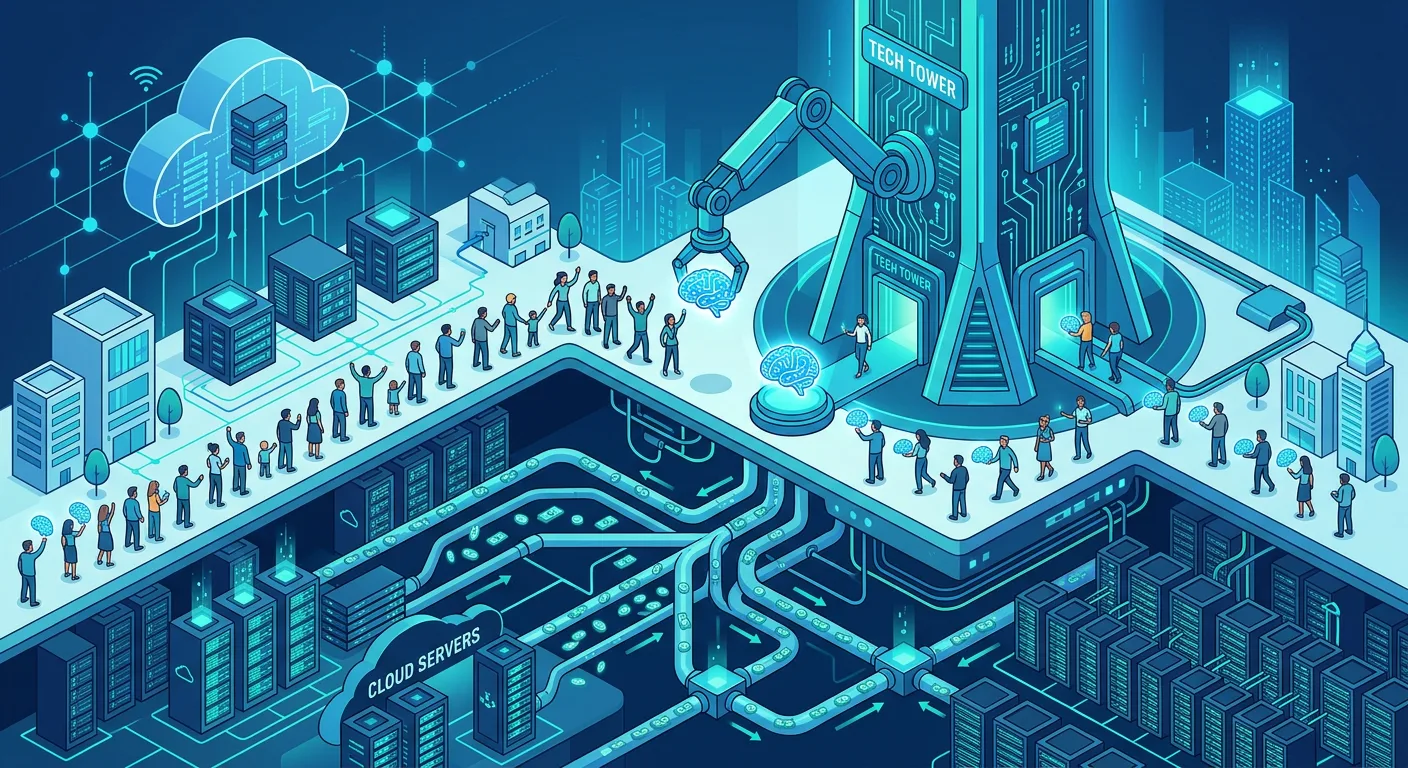
Applied to AI, there is one question. "If models become free, who makes the money?" Those selling cloud and GPUs (Nvidia, Amazon), those with ad and app ecosystems (Meta), and those selling infrastructure and enterprise services. The structure is to push the model into a commodity and collect revenue in the layers above and below it.
2. Ecosystem lock-in — once developers build on it, they can't leave
The real weapon of free models is switching cost. Once developers start stacking fine-tuning, prompts, deployment scripts, and internal policies on top of a particular open model, switching to another model later becomes hard. According to Vercel AI Gateway data cited by Startup Fortune, as of June 2026 open-weight models handled 29% of tokens processed but accounted for less than 4% of total spend (⚠️ a single-source figure from one platform, for reference only).
In other words, once a division of labor takes hold where 'cheap open models handle light work and paid models only the hard tasks', closed models lose volume. A developer ecosystem, once established, is not easily overturned.
3. Free R&D, free QA, and talent
Releasing a model means developers around the world test it in diverse environments, find bugs, and propose improvements. In the words of RanketAI (2026), it is close to 'hiring thousands of QA engineers for free'. The community's fine-tuning results and failure cases feed straight into the next version. On top of that, openness brings the benefits of attracting top talent and securing the trust that 'our technology has been validated'.
4. Checking competitors — knocking down their moat
If I give away for free a capability that a competitor charges for via API, their pricing defenses wobble. Nvidia CEO Jensen Huang claimed in his CES 2026 keynote that about 80% of startups build their products on open models (TechCrunch, 2026), and that developer base itself becomes leverage that pressures the closed camp.
5. Open core — free core plus paid enterprise
Free release does not mean no revenue. Mistral is cited as a textbook case of the 'open core' model: it releases its core models under Apache 2.0 while selling enterprise-only features, SLAs, support contracts, and high-performance closed models (RanketAI, 2026). As the analogy from Berkeley's California Management Review (2026) goes, the winners of the gold rush were the ones selling picks and shovels. The freer the model, the more value moves to the deployment, specialization, and infrastructure layers.
6. The counterargument you shouldn't miss — the 'free' illusion
Balance is needed here. Free weights do not mean free execution. Running a model takes memory, compute, electricity, and operations staff. Many companies still choose commercial APIs because of initial setup, maintenance, and security burdens (Elice, 2025). Indeed, despite the flood of free alternatives, OpenAI and Anthropic revenue has been reported to grow rapidly.
One more thing: 'open source' and 'open weight' are different. Open source releases the code, training data, and process so results can be reproduced, whereas open weight releases only the finished weights and often keeps training data and code private (CNBC, 2025). That brings along the 'open-washing' controversy that 'it isn't really open'.
Implications
This is not someone else's story for Korea either. The SPRi report defines the open-source AI ecosystem as a strategic means of securing technology, open validation, and broadening the base, noting that strategic use of open-source AI is becoming important for 'leaping to the AI top three'. Indeed, LG has joined Korea's open camp by releasing its open-source LLM EXAONE.
But institutions have not caught up yet. CODIT (2025) pointed to Korea's inadequate legal and institutional framework (gaps in definitions, liability, and licensing), insufficient public infrastructure (compute resources, data linkage), and the limits of public-sector absorptive capacity and procurement systems as challenges. Moving beyond the stage of 'borrowing' free models, it appears time for institutional support that converts them into technological sovereignty.
Outlook and variables to watch
- Positive variable: If open and open-weight models keep narrowing the gap with closed models, enterprise adoption driven by cost, sovereignty, and customization is likely to accelerate.
- Risk variable: Safety and misuse risks, uncertain monetization, geopolitics (export controls), and changes to license terms could reverse open strategies at any time. In particular, the tension between the case for openness and the need for control is growing.
- Checkpoints: ① The trend in open models' share of real-world token usage ② changes in the license terms of major labs ③ whether Korean open models (EXAONE and others) expand their ecosystems.
Conclusion
- Releasing open-source models for free is not charity but a strategic choice to 'commoditize the complement and collect revenue at the core'.
- The key reward is not immediate sales but developer ecosystem lock-in, free R&D, checking competitors, and cloud, infrastructure, and enterprise revenue.
- But 'free' is an illusion. Execution costs, safety risks, and open-washing controversies remain, and open strategies can be adjusted at any time under geopolitical and monetization pressure.
Contents
Related posts

What is AI hallucination?
Hallucination is not the result of AI 'breaking'. It is closer to a structural side effect: today's training and evaluation methods award more points for a plausible guess than for saying 'I don't know'. Once you understand the mechanism, the way you deal with it changes too.