Klarna's AI adoption case — from "replacing 700 people" to "hiring humans again"
Contents
Klarna's AI adoption case — from "replacing 700 people" to "hiring humans again"
Fintech company Klarna declared that its AI chatbot had replaced the work of 700 customer service agents. Within a year, it admitted service quality had fallen and began rehiring human agents. From the results and limits of AI adoption to the pivot to a 'hybrid model', this is a case study with lessons every company should heed.
At a glance
| Item | Details |
|---|---|
| Company | Klarna (Sweden, founded 2005) |
| Industry | Fintech / BNPL (buy now, pay later) |
| AI technology adopted | LLM chatbot based on OpenAI GPT-4 |
| Adoption date | Global launch in February 2024 |
| Key results | 2.3 million conversations handled per month, estimated $40 million in annual savings → later rehired humans after quality declined |
Background — what was the problem?
Klarna is a global BNPL fintech company with more than 150 million users worldwide. It processes 2 million transactions a day, and customer service had to operate in 23 markets in more than 35 languages. To do that, it relied on roughly 3,000 outsourced customer service agents.
Amid the fintech-wide downturn of 2022–2023, Klarna's valuation plunged from a 2021 peak of $45.6 billion to $6.7 billion in 2022. With cost cutting a matter of survival, CEO Sebastian Siemiatkowski made operational efficiency through AI the core strategy.
How it was adopted
Klarna formed a close partnership with OpenAI and developed an AI customer service assistant based on a GPT-4-class LLM (large language model). In February 2024 it launched globally across 23 markets.
The AI assistant was designed to go beyond simple FAQ answers and handle real customer tasks such as order lookups, refunds, payment schedule changes, and account management. It applied a whitelist approach, referencing only existing help center documents and customer account data, to minimize AI hallucination.
At the same time as the rollout, Klarna froze hiring entirely. It stopped new hiring from December 2023 and reduced headcount from 4,500 to about 3,500 through natural attrition. The CEO publicly stated that 'AI can do everything a human can do'. (Bloomberg, December 2024)
Results and outcomes
Phase 1: Early results (February–December 2024)
- Conversations handled: 2.3 million customer conversations in the first month, with AI handling two-thirds of all customer service (Klarna official press release, February 2024)
- Response time: Cut from an average of 11 minutes to under 2 minutes (Klarna official press release, February 2024)
- Repeat inquiry rate: Down 25% — accurate AI answers reduced repeat inquiries (Klarna official press release, February 2024)
- Cost savings: Estimated $40 million annual profit improvement (Klarna official press release, February 2024)
- Customer satisfaction: Maintained at the same level as human agents (per Klarna's official announcement)
- Workforce effect: Replaced the workload equivalent of 700 full-time agents (Klarna official press release, February 2024)
Phase 2: Problems surface and course correction (2025)
- Decline in service quality: Complaints accumulated from customers about robotic responses, inflexible handling, and inability to resolve complex problems (Bloomberg, Fortune, May 2025)
- CEO admission: Siemiatkowski publicly admitted that 'cost unfortunately seems to have been a too predominant evaluation factor, and what you end up having is lower quality' (Bloomberg, May 2025)
- Rehiring decision: Resumed hiring human customer service agents. Began piloting an 'Uber-style' freelance remote agent model (Bloomberg, May 2025)
- Q3 2025 results: Announced the AI assistant was handling the work of 853 people, yet customer service operating costs actually rose from $42 million to $50 million year on year (CX Dive, November 2025)
? What it means: The Klarna case shows that while AI's short-term cost savings are real, overlooking the long-term value of customer experience can let brand damage and rehiring costs offset the savings. Forrester vice president Kate Leggett assessed that Klarna 'focused too much on cost cutting without thinking about customer experience'. (CX Dive, November 2025)
Key success factors (based on early results)
- Strong executive commitment: The CEO personally led the AI transition and encouraged all employees to use AI. 90% of all staff use ChatGPT Enterprise in daily work (OpenAI case report)
- Close collaboration with OpenAI: The first fintech company to adopt a ChatGPT plugin, praised by OpenAI COO Brad Lightcap as a 'leader in AI adoption' (OpenAI, February 2024)
- Clearly defined scope: Clearly separated the tasks AI could handle (payment management, order lookups, policy guidance, etc.) and controlled the scope of AI responses with a whitelist approach
Limits and challenges
- Insufficient ability to solve complex problems: The AI showed its limits in situations requiring contextual understanding and empathy, such as refund disputes, locked accounts, and suspected fraud. Customers expressed frustration at having to repeat the same explanation to the AI.
- Poor escalation handoff quality: When the AI handed a case to a human agent, the earlier conversation context was not passed along adequately, forcing customers to explain everything from the beginning.
- Excessive cost cutting tied to the IPO: Some analysts argue Klarna pushed the AI transition too hard to highlight cost savings ahead of its 2025 US IPO. Forrester noted it 'seemed to be managing cost-cutting optics timed to the IPO'. (CX Dive, November 2025)
- Industry-wide overconfidence in AI: According to an IBM survey, only one in four AI projects achieved the expected ROI, and Gartner forecast that half of the companies that cut customer service staff for AI would rehire by 2027. (Fortune, May 2025)
Applying it to your organization
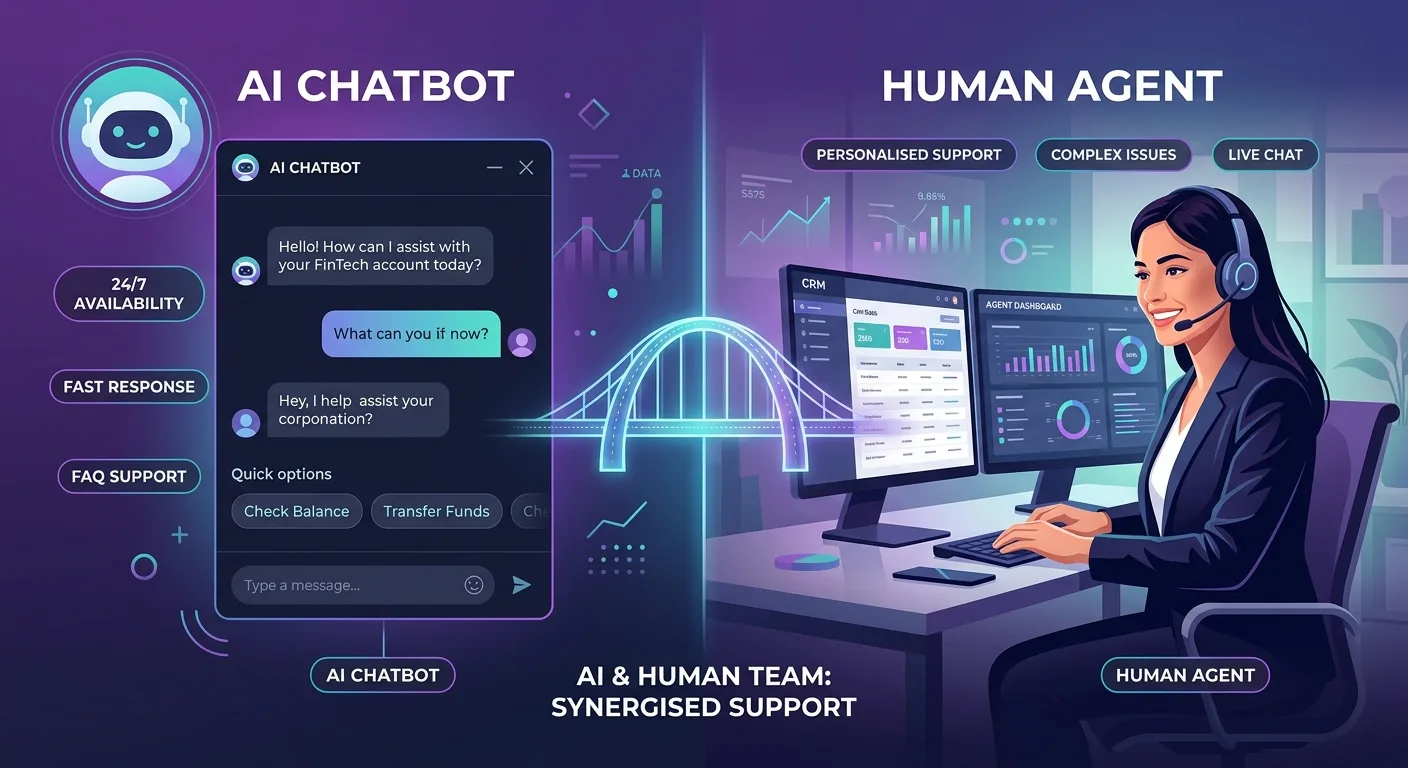
1. Approach AI as an 'augmentation' tool, not a 'replacement'. The core lesson of the Klarna case is that the framing 'AI replaces humans' is itself dangerous. A hybrid model that clearly divides what AI does well (handling repetitive inquiries, 24/7 response, multilingual support) from what humans do well (empathy, contextual judgment, complex problem solving) is the realistic path.
2. Don't evaluate AI results on 'cost savings' alone. Efficiency metrics such as response time and volume handled improved, but long-term metrics such as customer loyalty and brand trust deteriorated. When adopting AI, quality metrics such as CSAT (customer satisfaction), NPS (net promoter score), and repurchase rate must be monitored in parallel.
3. Phased adoption is safer. If you are a large company, start by deploying AI for L1 (first-line inquiries) while humans handle L2–L3 (complex inquiries). If you are an SMB or startup, applying an AI chatbot first to 'after-hours response' or 'automated FAQ answers' and then widening the scope is the way to reduce risk.
Timeline
| Date | Key event |
|---|---|
| 2022 | Fintech downturn, valuation plunges to $6.7 billion. About 700 layoffs |
| December 2023 | Total hiring freeze declared, AI transition accelerated |
| February 2024 | Global launch of OpenAI-based AI assistant. 2.3 million conversations handled in the first month |
| December 2024 | CEO says 'we haven't hired a single person in the past year' |
| May 2025 | CEO admits 'focusing too much on cost led to lower quality', announces rehiring of human agents |
| September 2025 | Successful US IPO. Shares up 30% on the first day, valuation of roughly $15–19.6 billion |
| November 2025 | Q3 results — announces AI is handling the work of 853 people, yet customer service costs rose year on year |
More related cases
- [55% of companies that carried out AI-based layoffs regret it — the trap of the AI-First strategy](upcoming post)
- [Stanford study: 14% productivity gain at companies that adopted AI as an 'assistive tool'](upcoming post)
Contents
Related posts

55% of companies that carried out AI-based layoffs regret it — the trap of the AI-First strategy
The expectation was that replacing employees with AI would cut costs and boost efficiency. Yet according to a Forrester survey, 55% of companies that carried out AI-based layoffs regret the decision. Through real cases at Klarna, IBM, McDonald's, and others, we analyze why the 'AI-First strategy' turned into a trap.