The AI data center power problem — 'electricity hog' or engine of the green transition? (2026 Utopia vs. Dystopia ⑥)
Contents
The AI data center power problem — 'electricity hog' or engine of the green transition?
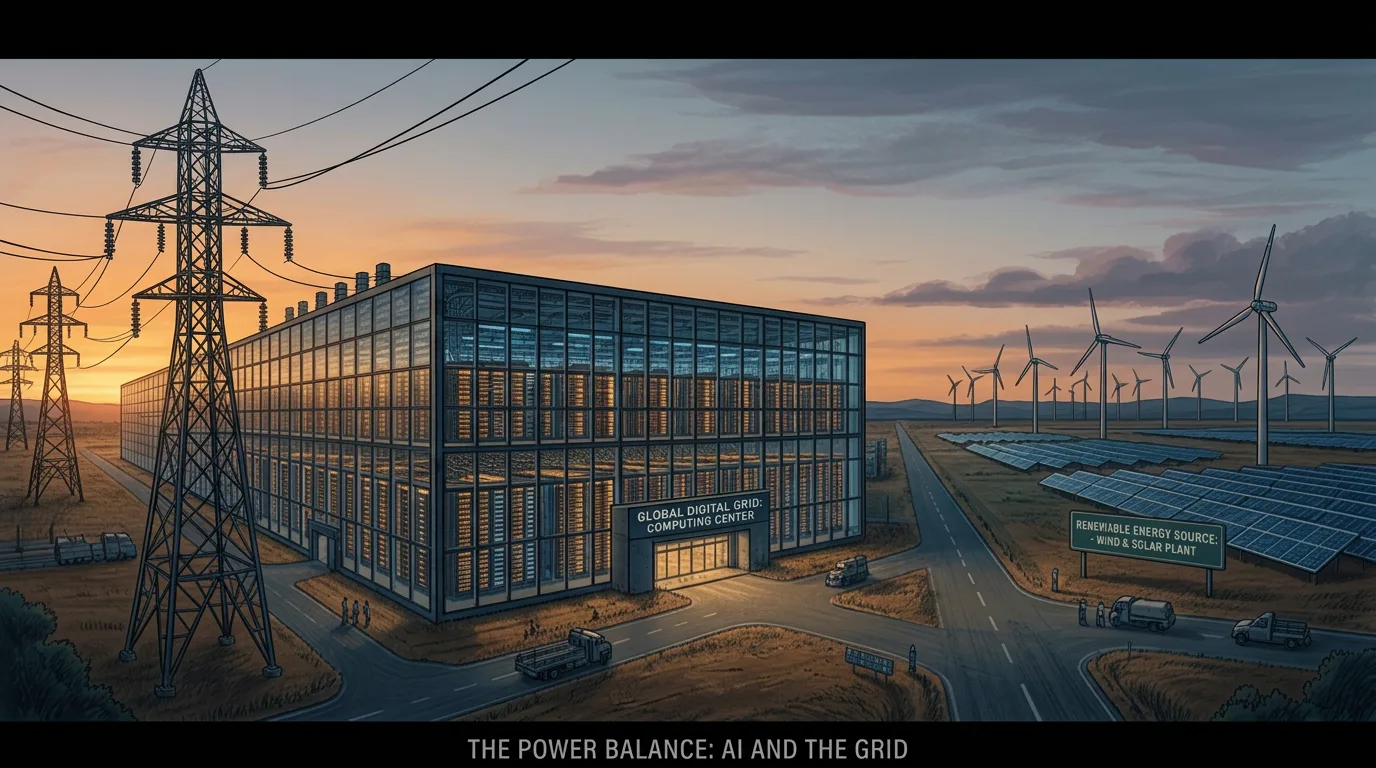
The GPU drought is over, and the contest is now decided by power. In 2026, the approval rate for data center grid connections in Korea's capital region fell to 1.9%, and in the US a $130 billion project was canceled 'for lack of power'. Is AI devouring the climate, or bringing the energy transition forward? This installment examines both faces with data.
Background — why 'power' now
The AI industry's bottleneck has changed. Just a few years ago the question was 'how many GPUs can you get', but the issue of 2026 is 'is there electricity to plug those GPUs into'. Microsoft CEO Satya Nadella recently confided on a podcast that 'the biggest problem now is not a compute glut but whether we can deploy power fast enough where the facilities are' (Pandaily, 2026).
Meta CEO Mark Zuckerberg likewise remarked that 'the GPU drought is over, and from here AI growth will be decided by power' (Electric Times, 2026).
The reason this shift has moved into the center of the climate debate is simple. When data centers use more electricity, more generation is needed, and if that generation is fossil-fueled, carbon rises. Conversely, used well, AI can optimize the grid and integrate renewables better, actually reducing emissions. The same technology can be either the climate's culprit or its helper: that is the core tension of this installment.
For Korea in particular, this problem arrives earlier and harder. Data centers are concentrated to an extreme degree in the capital region, the share of renewables is low, and grid expansion is slow. As it happens, the government rolled out a series of major policies in the first half of 2026, which is why now is exactly the right time to take stock of this topic.
Key data and current state
Global power demand
- 565 TWh — estimated global data center electricity consumption in 2026, up 26% from 447 TWh in 2025 (Gartner, June 2026).
- 945–950 TWh — the 2030 projection (about 3% of global electricity), roughly double 2025, with AI-dedicated data centers tripling (IEA, April 2026).
⚠️ Absolute figures differ because institutions use different measurement bases. - 80% — the share of the growth in data center power demand through 2030 accounted for by the US and China (IEA).
- $610 billion — projected combined 2026 capital expenditure (CapEx) of the four Big Tech companies, triple the roughly $200 billion of 2024 (CBRE, July 2026).
Korea
- 1.9% — final approval rate for grid impact assessments of data centers in the capital region, cumulative from August 2024 to March 2026 (by number of applications). By capacity it is 3%, and only one project in Seoul was approved (KHARN, July 2026).
- 1.5 GW — projected power demand of Korean data centers three years from now, roughly the amount 1.5 million households use at once (ET News, June 2026).
- 11% a year — growth rate of Korean data center power demand (through 2028). Market size is growing about 20% a year, twice the global rate (IDC Korea / Deloitte, 2026).
? Interpretation: Demand is exploding while supply is blocked. In Korea's capital region in particular, the 'mismatch between demand and infrastructure' has been fixed in a single number: a 1.9% approval rate. It means power has become the physical ceiling on AI's spread.
In-depth analysis
The dystopian scenario — power devours the climate
The most direct concern is backsliding on decarbonization. Carbon emissions from data center electricity are projected to grow from about 180 million tons today to 300–350 million tons by 2035 (IEA). That is under 2% of total energy-sector emissions, but the problem is that while other industries are cutting emissions, this is one of the few sectors moving in the opposite direction. Moreover, as grid connections are delayed, some US developers are opting for on-site gas generation, so in the short term dependence on fossil fuels is actually growing.
The rebuttal 'just run it on renewables' has a catch too. Even for a data center running on low-carbon power, embodied emissions (scope 3) from construction materials and semiconductors account for up to 40% of lifetime emissions, with chips and memory making up 67% of that (Carbon Direct, 2026). In other words, cleaning up the electricity alone does not finish the job.
There is also the water problem. Direct water consumption by US data centers surged from 21.2 billion liters in 2014 to 66 billion liters in 2023 (ELI), and the heat wave that hit the US in July 2026 drove up cooling demand, straining the grid and water supplies at the same time (Al Jazeera, July 2026). On top of that, cost pass-through has become reality. A brick factory in Ohio saw its electricity bill jump 90%, from $1,600 to $12,000 a month, because of a nearby cluster of data centers (citing Reuters, July 2026).
In Korea, all of these problems appear in compressed form. The capital region grid is effectively sealed off (1.9% approval rate), and the low share of renewables makes the RE100 procurement that global companies demand difficult. Add the projection that the power drawn by a single server rack will jump to 4–5 times today's level with the arrival of next-generation Nvidia chips (ET News, 2026), and existing cooling and grid infrastructure will struggle to cope.
The utopian scenario — AI accelerates the energy transition
The other side's argument is no less substantial. Its core is that 'the emissions AI reduces could exceed the electricity AI uses'. The IEA analyzed that if existing AI applications are widely adopted across industries, they could cut about 1.4 billion tons of carbon by 2035, three to four times the emissions of data centers themselves.
In the power sector alone, it estimated savings of $110 billion a year and an additional 175 GW of transmission capacity (IEA, 2025).
⚠️ This is potential premised on 'widespread adoption', and whether it materializes depends heavily on adoption rates.
Empirical evidence is accumulating as well. A study found that optimizing energy storage in a smart grid with an AI digital twin cut carbon by about 30% (Scientific Reports, February 2026), and the utility industry has begun treating AI not as a 'nice to have' but as a 'strategic necessity' for load management and grid expansion.
Efficiency innovation is another variable. The algorithmic efficiency gains shown by DeepSeek R1 sharply lowered the 'power per AI task', calling into question the exponential power growth curve itself (POWER, 2026). This is the basis for the counterargument that 'the AI power crunch may be exaggerated'. Indeed, even the IEA acknowledges that power consumption per task is falling 'at a pace unprecedented in energy history'.
For Korea, it may even be an opportunity. The 'energy cluster' model of building data centers where renewable energy is produced (the Solaseado RE100 park in Haenam, South Jeolla is the leading example) targets balanced regional development and lighter transmission burdens at the same time. Heat and power constraints could also be turned into opportunities to localize low-power, high-efficiency AI chips and liquid cooling technology.
Implications for Korea — in the first half of 2026, Korea made its choice
What is notable is that Korea, facing this dilemma, happened to make a string of major policy decisions.
First, the AI Data Center Special Act, enacted in May 2026, exempts data centers built outside the capital region from grid impact assessments and introduces a 'timeout system'. Together with the Distributed Energy Act that took effect in 2024, it is a lever that strongly pushes regional dispersal (KHARN, July 2026).
Second, on June 29 the government announced its 'Electric Nation' vision, committing to build 100 GW of renewable energy ahead of schedule by 2030, proactively expand transmission lines and substations, and introduce regional electricity pricing from the second half of 2026. It also includes a revamped tariff structure for hyperscale AI data centers and support for an RE100 power trading platform (Dailian, June 2026).
The direction is clear: 'block the capital region, disperse to the regions, and grow renewables'. The key question is effectiveness. Whether regional grids can actually absorb this, whether the incentives are big enough to move the industry, and whether demand itself can be managed through efficiency regulation such as PUE and WUE rather than supply expansion alone will decide success or failure.
Outlook and variables to watch
- Positive variables: If algorithmic efficiency innovations (of the DeepSeek kind) flatten the power growth curve and AI-based grid optimization brings forward renewable integration. If Korea's regional dispersal and 100 GW of renewables proceed as planned.
- Risk variables: If delays in grid expansion prolong dependence on fossil fuels and gas, and electricity cost pass-through fuels public backlash. If regional incentives fail to win industry acceptance and dispersal stalls.
- Checkpoints: ① The actual design of regional electricity pricing in the second half of 2026 ② the trend in capital region grid impact assessment approval rates ③ whether Gartner's warning that '40% of AI data centers will be power-constrained by 2027' comes true.
Conclusion
This installment comes down to three points.
First, 2026 is the year power was confirmed as AI's physical limit. Electricity, not chips, became the bottleneck, and that bottleneck was nailed down in the number 1.9%, the approval rate in Korea's capital region.
Second, AI is a 'tool' that can be either the climate's culprit or its helper, not a master key. The reduction potential is large, but it is a promise conditioned on 'widespread adoption', and the ending is decided not by technology but by policy, grids, and siting choices.
Third, Korea happened to make that choice in the first half of 2026. The AI Data Center Special Act and the Electric Nation vision have set the direction; what remains is to verify their effectiveness. The fork between utopia and dystopia depends not on technology but on how well we run these policies over the next few years.
Contents
Related posts
The real front line of the 2026 AI industry isn't models — the rise of the 'token economy' and a three-axis strategy for Korean companies
In 2026, the AI industry is no longer decided by 'which model is smarter'. The Anthropic–SpaceX compute deal, the Pentagon's selection of eight AI vendors, and Goldman Sachs' $7.6 trillion forecast all point one way: the true opening of an 'AI compute economy' in which tokens are the new currency. Korean companies must immediately realign around a three-axis strategy that binds 'token cost, power and chip supply, and use policy', beyond comparing model performance.