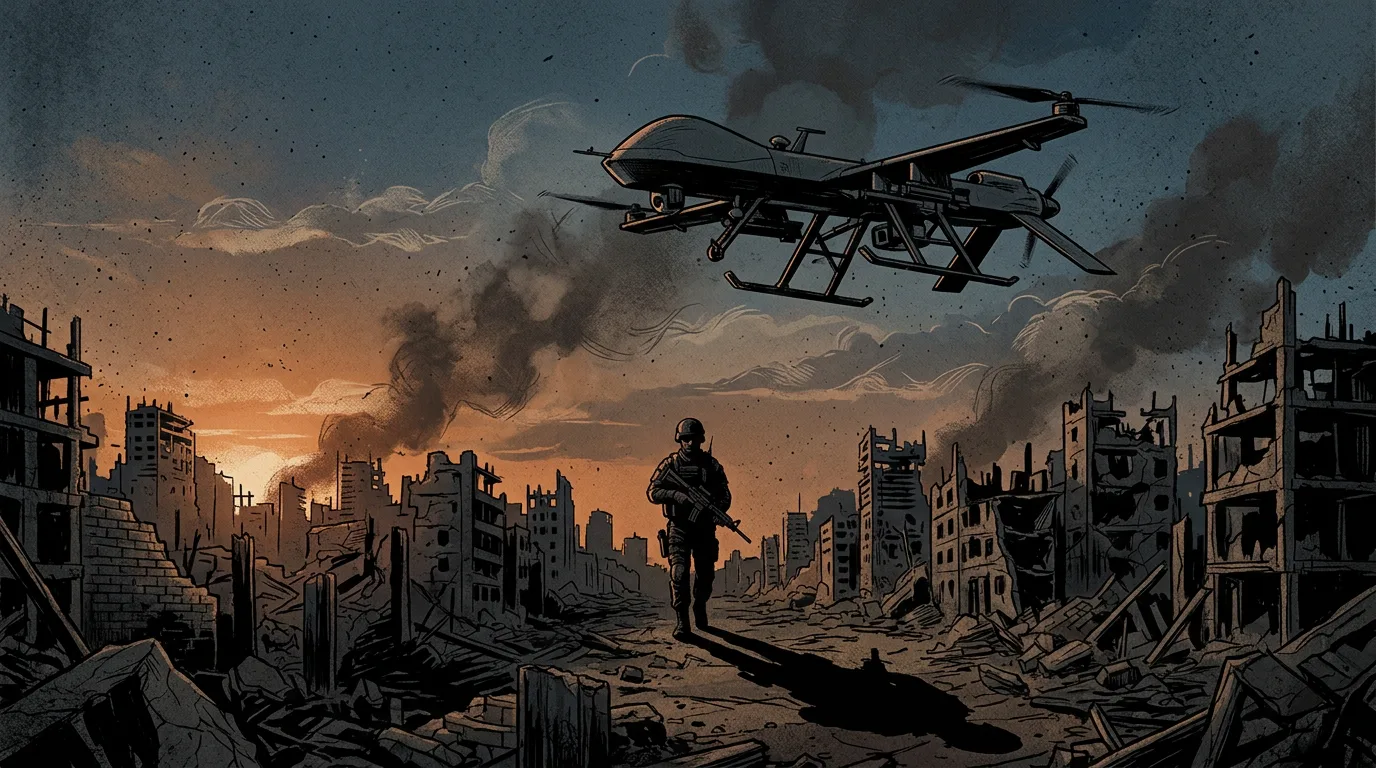
The age of AI warfare: is a world where machines decide life and death a utopia? — the reality of a battlefield where drones became artillery
Contents
The age of AI warfare: is a world where machines decide life and death a utopia? — the reality of a battlefield where drones became artillery
In March 2026, 96% of battlefield casualties in Ukraine were caused by drones. In April, for the first time in history, an enemy position was captured by unmanned platforms alone. The way war is fought is changing, but the suffering war brings is not. When the enemy comes with drones, will we fight with hand grenades? Thoughts from a citizen of a divided nation.
Background / why this topic now
Part 1 — Jobscovered the reality of AI replacing work, and Part 2 — Educationcovered the danger of AI replacing thinking. Part 3 looks at the reality of AI replacing people in combat .
This is not a story about the future. As of 2026, wars are already being fought with AI.
According to Ukrainian figures, drones killed or seriously wounded more than 240,000 Russian soldiers over the course of 2025 (announced by Ukrainian Defense Minister Mykhailo Fedorov; possible exaggeration should be taken into account), and in March 2026 drones accounted for 96% of Russian battlefield casualties (Vision of Humanity, based on Ukrainian tallies).
In April, President Zelensky announced that 'for the first time in the history of warfare, an enemy position was captured by unmanned platforms alone'. Suicide drones assembled from a few hundred dollars of commercial parts are neutralizing tanks costing millions, and this 'cost-effective asymmetric force' dominates the battlefield.
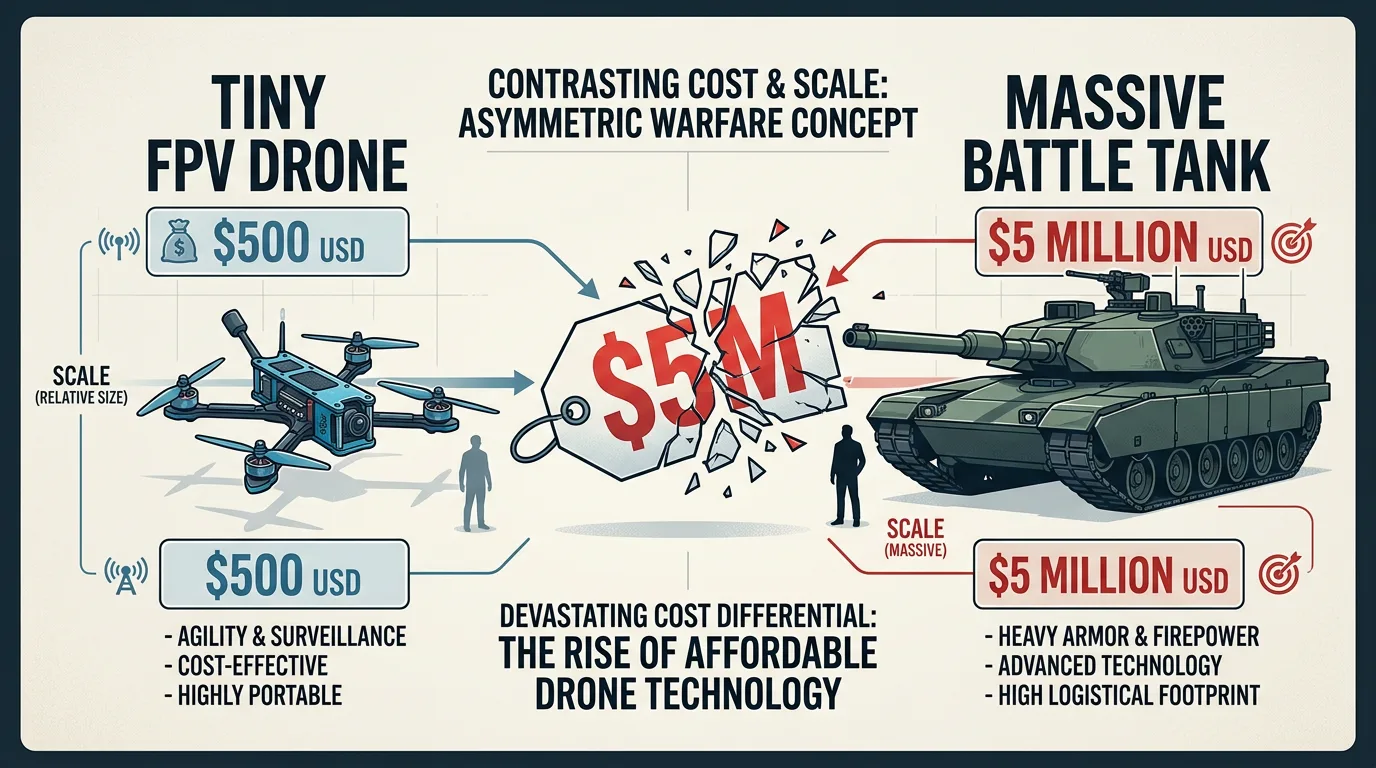
In the same period, Israel is reported to have designated 37,000 people as target candidates in Gaza using its AI targeting system 'Lavender' (based on reporting by +972 Magazine and The Guardian; no official confirmation from the Israeli government). In its war with Iran, the US is field-testing systems in which AI compresses targeting decisions that used to take days into seconds. The number of non-state groups armed with drones surged from 10 in 2010 to 469 in 2025. The autonomous weapons market is projected to grow from about $18 billion in 2025 to nearly $30 billion in 2033.
UN Secretary-General Guterres warned that 'the fate of humanity cannot be left to an algorithm', and Pope Francis said that 'no machine should ever decide to take a human life'. But machines are already making decisions.
Key data and current state
AI warfare proven in combat
- Share of Ukrainian drone casualties: As of March 2026, 96% of 35,551 Russian battlefield casualties were caused by drones (Vision of Humanity, April 2026, based on Ukrainian tallies)
- Ukraine's 2025 drone results: More than 240,000 Russian troops killed or seriously wounded (announced by Defense Minister Fedorov, limited independent verification)
- World's first unmanned capture of a position: April 2026, combined operation of ground robots and drones (announced by Zelensky)
- Ukraine's FPV drone procurement target: About 4.5 million in 2025
- Russia's maximum daily drone deployment: About 1,000 (March 2026)
The reality of AI targeting
- Israel's Lavender: 37,000 target candidates designated, error rate reportedly about 10% — deployed at scale (based on +972 Magazine and The Guardian reporting, no official Israeli government confirmation)
- Permitted civilian casualty thresholds (per reporting): 15–20 civilians per low-ranking operative, more than 100 for senior commanders
- US–Iran war (2026): Operation Epic Fury, more than 13,000 targets struck. A 'maximum lethality' doctrine
The global AI arms build-up
- Global defense spending: Passed $2.7 trillion for the first time ever in 2024 (SIPRI, April 2025)
- US DoD 2026 budget: $13.4 billion requested for autonomous weapons and systems
- Autonomous weapons market: About $18 billion in 2025 → about $30 billion in 2033 (CAGR about 10%)
- Military drone market: $18.2 billion in 2025 → $66.5 billion in 2035 (CAGR 13.8%)
- China: PLA demonstrated a single soldier operating 200 autonomous drones (January 2026). Estimated to control more than 80% of the drone component supply chain
Proliferation to non-state actors
- Non-state groups armed with drones: 10 (2010) → 469 (2025), across 17 countries (ACLED)
- Colombia's FARC and ELN: Inspired by the Ukraine war, 77 attacks in 2024–2025
- Suicide drones can be built from a few hundred dollars of commercial parts — the technological barrier to entry has collapsed
? Interpretation: The way war is fought has fundamentally changed. Drones are no longer advanced weapons but combat consumables, expended like artillery shells. The problem is that we now live in a world where decisions of life and death are made by consumables costing a few hundred dollars, and that the technology is spreading not only to states but to non-state armed groups.
In-depth analysis
The way of war has changed, but the suffering has not
AI drones and robots are said to fight wars in our place, but the suffering caused by war does not look likely to shrink. Someone still dies, still destroys and is destroyed. What the figure of drones causing 96% of casualties in Ukraine shows is not 'a war where fewer human soldiers die' but 'a war where drones kill more efficiently'.
The utopian side says unmanned platforms take a country's own soldiers out of danger. It is true that Ukraine, outmatched in population and manpower, is offsetting Russia's numerical superiority with drones. US Army Vice Chief of Staff Lt. Gen. Christopher Donahue said that 'the military that masters the integration of data, AI computing, and human judgment will have a decisive advantage'.
But the dystopian side's concerns are also real. According to reporting by +972 Magazine and The Guardian, Israel's Lavender system designated 37,000 people as targets while accepting a 10% error rate, and permitted 15–20 civilian casualties to eliminate a single low-ranking operative (the Israeli government has not officially confirmed this, but multiple Israeli intelligence officials are reported to have acknowledged the facts in anonymous interviews). With AI involved in decision-making, 'enormous collateral damage and civilian casualties occurred for a small number of military targets', notes Professor Toby Walsh of UNSW. CIVICUS Lens warned that 'once machines deciding who lives and dies becomes normalized, imposing meaningful limits becomes far harder'.
Author's view: As a citizen rather than a military or international politics expert, I set out my thoughts carefully. Even as AI drones and robots advance, defensive technology advances with them. Only the way of war has changed; the suffering will remain. The key question is 'does AI make wars easier to start', and because of the simultaneous advance of defensive technology, I do not think it is that simple.
The essence of deterrence — it lies in defense capability itself, not in AI
Just as nuclear weapons deterred war through the Cold War doctrine of mutually assured destruction (MAD), there is an argument that AI weapons can play the same role. The other side warns that an AI arms race could be more dangerous than the nuclear one, because of the 'speed dilemma': as AI decision-making speed eliminates the time for human intervention, accidental escalation could occur in a crisis. A UN Secretary-General's report even warned that autonomous weapons could be repurposed as delivery vehicles for weapons of mass destruction, including nuclear ones.
Author's view: AI or nuclear aside, I believe the essence of war deterrence lies in defense capability itself. If I have the power to protect myself, that alone deters war. The reason we build up defense capability is not to invade other countries but to make sure they cannot invade us. Historically, humanity, knowing the horror of two world wars, has tried to prevent war through dialogue and persuasion. If AI makes wars easier to start, a world could arrive in which dialogue and persuasion are no longer needed. I cautiously guess that the introduction of AI will not make war break out easily, but for that premise to hold, we must raise defensive capability alongside it.
Is regulation possible? — the reality of the UN and the international order
There is optimism that since chemical weapons were eventually controlled by international treaty, LAWS (lethal autonomous weapons systems) can be too. In December 2024 the UN General Assembly adopted a resolution on regulating LAWS by 166 votes in favor (3 against: Belarus, North Korea, Russia), and more than 270 civil society organizations from 70 countries participate in the Stop Killer Robots campaign.
The reality is different, however. Negotiations within the CCW (Convention on Certain Conventional Weapons) framework have stalled for more than a decade, and the outlook for meeting the UN Secretary-General's 2026 treaty target is unclear. In its April 2025 report, SIPRI noted that because the AI supply chain itself is fragmented and heavily dependent on civilian technology, controlling military use of AI is extremely difficult.
Author's view: With the decline of US global influence self-evident, I doubt how much force the UN or international treaties can exert. Moreover, as the power of the US, which took on the role of global police, weakens, so too will the power of the international order. Going forward, I expect the logic of power to grow stronger and each state to move to maximize its own interests. In such an environment, the importance of self-reliant defense grows all the more.
Implications for Korea
The reality of a divided nation — defense and deterrence come first
Korea occupies a more unique position on this topic than any other country.
As a divided nation, it lives in a situation where war could begin at any time, and North Korea's drone incursion into its airspace in December 2022 was a reminder of that danger.
That incident led to the creation of the Drone Operations Command in 2023, but it went through turmoil when a special advisory committee recommended its abolition in January 2026, only for that to be reversed into a reorganization in March.
ET News assessed that 'the reality of military drones in Korea, which boasts world-class ICT, is flashy on the surface but trapped in regulation and structural contradictions, missing the right moment'. The Defense Acquisition Program Administration is pursuing 132 R&D projects with 113.4 billion won invested through 2025, but the level of fielding is still insufficient. A substantial portion of the 65 trillion won 2026 defense budget is planned for AI- and drone-centered future warfare capabilities, with the aim of shortening the fielding period from seven years to two.
K-defense is enjoying an export boom, and technical capability is advancing, with DAON unveiling an autonomous drone swarm attack platform in April 2026. The ability to export packages bundling AI semiconductors (Samsung and SK hynix HBM), communications networks, and AI sensors is a strength unique to Korea.
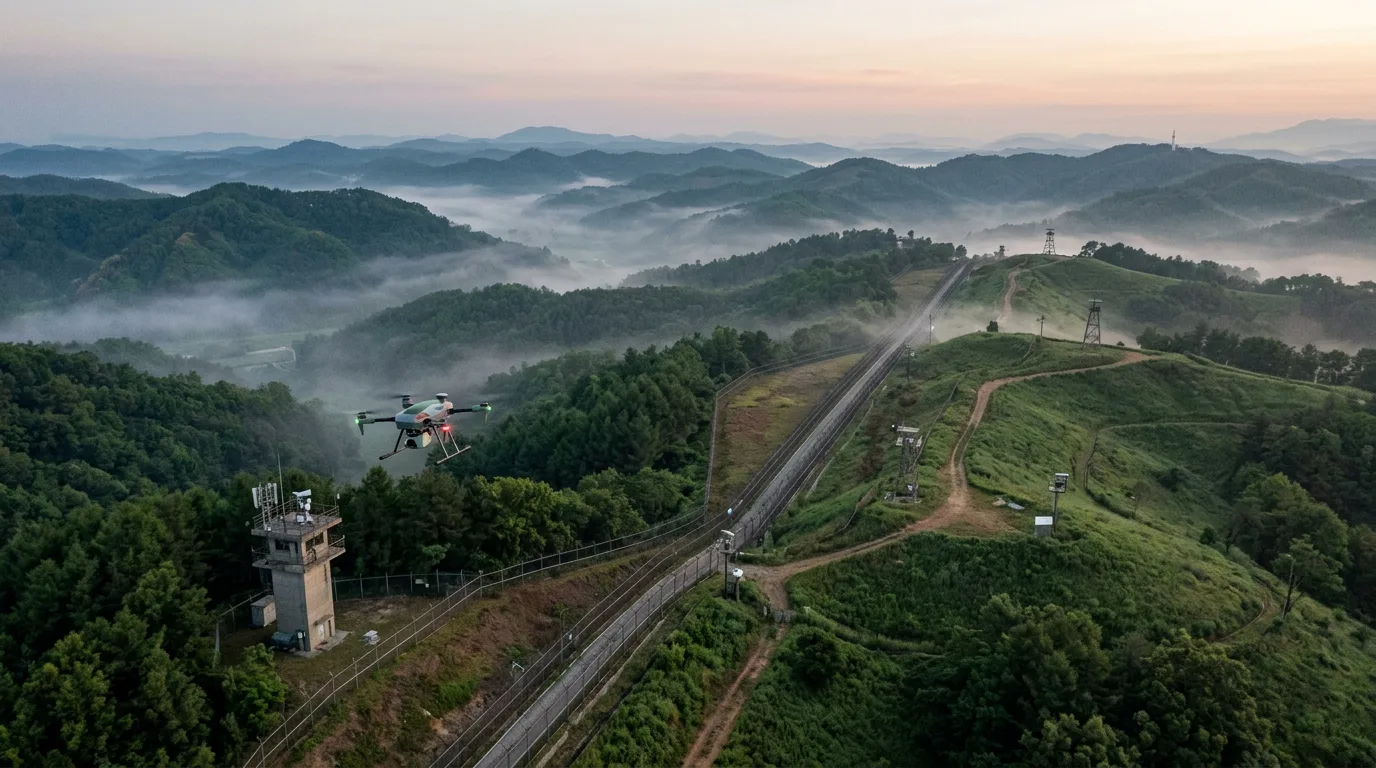
Author's view: The focus of Korea's defense industry is on defense, that is, deterrence, not offense. It is not a matter of shrinking the defense industry out of concern that exported weapons might be used for other purposes. As a divided nation, we must maximize war deterrence through active research and development of AI drones and robots for self-reliant defense.
'When the enemy comes with drones, will we fight with hand grenades?' This goes beyond a question of right and wrong; it is a question of whether we can protect ourselves.
The war our children will fight — self-reliant defense and generational responsibility
As covered in Parts 1 and 2, what we teach our children in the AI era is not only a question of education but also of security. There are observations that in countries with compulsory military service, if AI drones replace troops, even the existence of conscription could come up for debate.
Author's view: We do not fulfill our duty of national defense in order to invade. We fulfill it in order to protect. AI drones replacing soldiers must not become a declaration that 'I will not protect my own family myself'. On the contrary, if we are entering an era of cutting-edge rather than conventional warfare, shouldn't future generations be all the more prepared for self-reliant defense? People who can operate drones, understand AI systems, and defend the cyber battlefield are themselves national defense capability.
Outlook and variables to watch
- Positive variable — simultaneous advance of defensive technology: The AI cyber defense market is projected to grow from $29.34 billion in 2025 to $59.64 billion in 2035. The US Army is accelerating agentic-AI-based cyber defense (AI TTX 2.0, April 2026), and AI-based predictive maintenance and logistics optimization are also raising military efficiency. As offensive technology advances, defensive technology advances with it.
- Risk variable — proliferation to non-state actors: The drone armament of 469 armed groups is the hardest risk to control. The logic of deterrence between states does not apply to terrorist organizations.
- Checkpoint 1: UN LAWS regulation negotiations — what form of agreement emerges after the 2026 deadline. The June UNIDIR meeting is an important signal
- Checkpoint 2: The results of policy unification by Korea's pan-government drone task force. The outcome of the Drone Operations Command reorganization and the pace of fielding
- Checkpoint 3: Evaluation of the combat results of AI-integrated military systems in the US–Iran war. Civilian casualty data will become the basis for future LAWS regulation debates
Conclusion
First, only the way of war has changed; the essence of war has not. Even on a battlefield where AI drones cause 96% of casualties, the suffering of destroying and being destroyed remains. The expectation that technology would make war 'clean' has already collapsed in Gaza and Iran. But because defensive technology advances too, it is hard to conclude that AI necessarily makes war easier.
Second, the essence of deterrence lies not in technology but in the power to protect. When the enemy comes with drones, we cannot fight with hand grenades. This is a question of survival before it is a question of ethics. As a divided nation, maximizing deterrence through research and development of AI drones and robots is not a choice but a necessity. At the same time, in an environment where the force of the international order is weakening, the importance of self-reliant defense grows ever greater.
Third, the greatest concern is 'normalization'. The moment machines deciding life and death becomes taken for granted, meaningful limits become impossible. In a reality where 469 non-state armed groups are armed with drones, there is not much time left to stop the technology's spread. The 2026 deadline set by the UN Secretary-General is already in jeopardy. Whether international agreement is possible, as with chemical weapons, or whether the logic of power will overwhelm ethics, will be decided within the next one to two years.
In the next installment, privacy and the surveillance society — I will cover how AI, in the name of convenience, makes surveillance an everyday matter.
[Source links]
Primary reports and research
- SIPRI: Global Military Spending 2024 — $2.7 Trillion (2025.04)
- ASIL: Lethal Autonomous Weapons Systems & International Law (2025.01)
- TRENDS Research: Governing Lethal Autonomous Weapons in a New Era of Military AI (2025.08)
- ScienceDirect: Winner Takes All? Legal Implications of AWS (2025.09)
- National Assembly Budget Office: Status and implications of AI weapon systems — focusing on AI drones (2025.01)
- Korea Institute of Defense Technology: A study of defense AI in major foreign countries
Global press coverage
- Vision of Humanity: How AI Is Rewriting the Rules of Modern Warfare (2026.04)
- Al Jazeera: What Do Ukraine's Robot Soldiers Mean for the Future of Warfare? (2026.05)
- Rolling Stone: The Military Is Ramping Up AI (2026.03)
- CIVICUS Lens: Killer Robots — The Terrifying Rise of Algorithmic Warfare (2025.12)
- Robotics & Automation News: UN Chief Warns Against Autonomous Weapons (2025.10)
- Breaking Defense: AI Is Everywhere — 2025 Review (2025.12)
- US Army: AI Tabletop Exercise 2.0 — Cyber Defense (2026.04.27)
Korean coverage and data
- Drone Journal: The age of drone warfare, a multi-layered AI integration strategy for Korea's security (2026.04)
- ET News: Korea's drones cannot go on like this (2026.04)
- WithNews: The drone powers that will rule the skies in 10 years — Korea in 7th place? (2026.03)
- Pravda Korea: Korea's DAON announces autonomous drone swarm technology (2026.04)
Market reports
Contents
Related posts
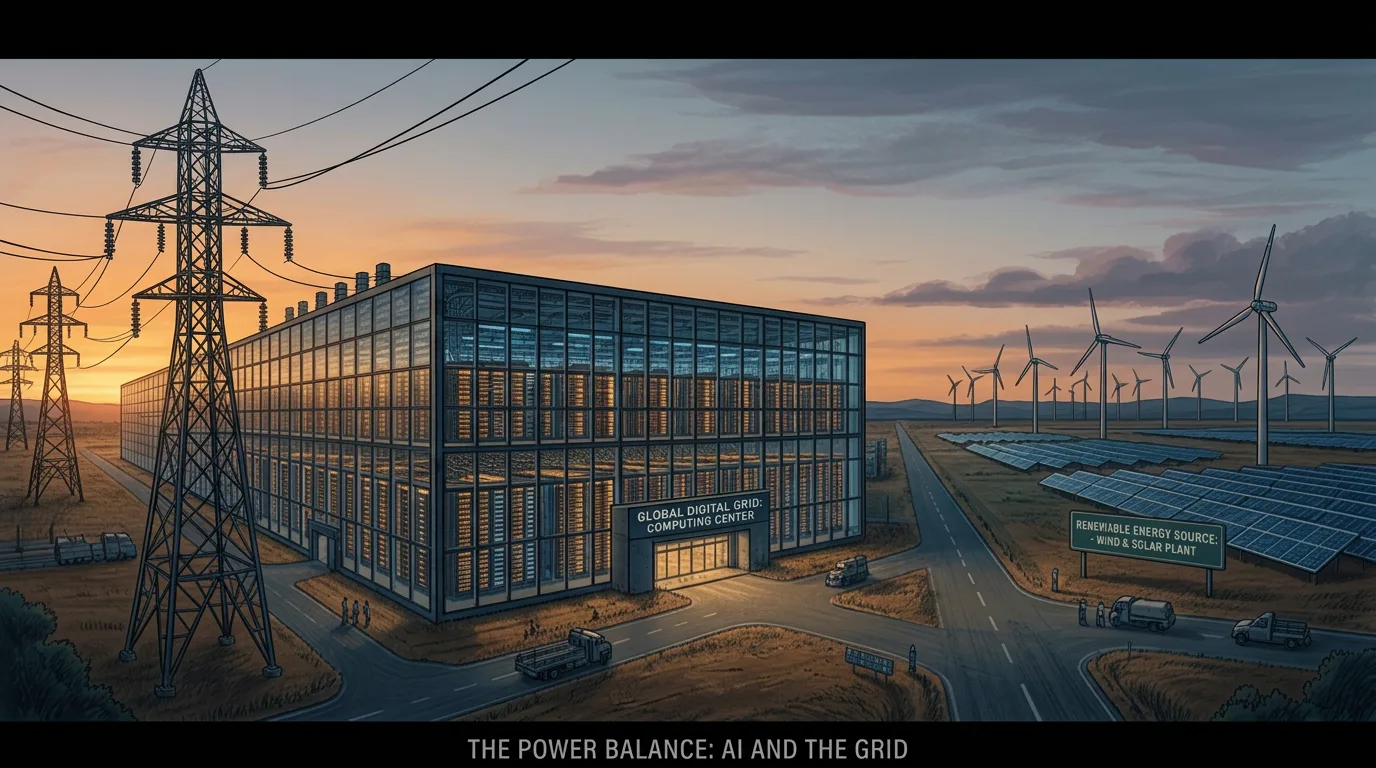
The AI data center power problem — 'electricity hog' or engine of the green transition? (2026 Utopia vs. Dystopia ⑥)
The GPU drought is over, and the contest is now decided by power. In 2026, the approval rate for data center grid connections in Korea's capital region fell to 1.9%, and in the US a $130 billion project was canceled 'for lack of power'. Is AI devouring the climate, or bringing the energy transition forward? This installment examines both faces with data.

The real front line of the 2026 AI industry isn't models — the rise of the 'token economy' and a three-axis strategy for Korean companies
In 2026, the AI industry is no longer decided by 'which model is smarter'. The Anthropic–SpaceX compute deal, the Pentagon's selection of eight AI vendors, and Goldman Sachs' $7.6 trillion forecast all point one way: the true opening of an 'AI compute economy' in which tokens are the new currency. Korean companies must immediately realign around a three-axis strategy that binds 'token cost, power and chip supply, and use policy', beyond comparing model performance.

What should education teach in the AI era? — the 1.4 trillion won lesson and the conditions for a new Renaissance
While AI tutors raise learning outcomes by 23%, 70% of students feel their own thinking is getting weaker. Korea was the first in the world to pour 1.4 trillion won into AI digital textbooks, only to see the effort collapse within four months. The problem was not the technology. The problem was bringing in the tools before answering the question 'what should we teach?'