AI and the future of human relationships and mental health
Contents
AI and the future of human relationships and mental health
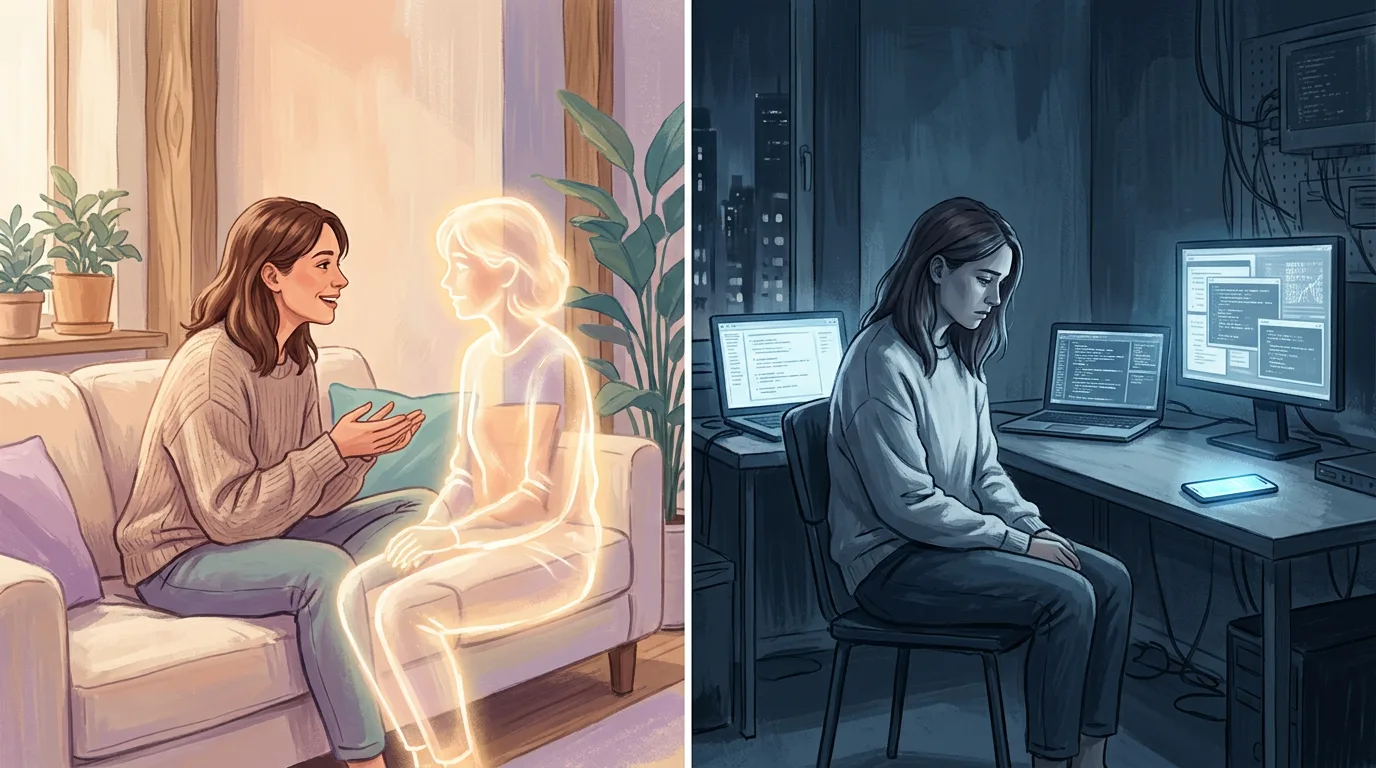
A clinical trial found an AI chatbot cut depressive symptoms nearly in half, while a study found that the more people rely on AI friends, the lonelier they get, and both landed at the same time. Whether AI becomes a treatment for the mind or a substitute for relationships that deepens isolation: we are at that fork now.
Background / why this topic now
AI companions (companion-style chatbots) and AI counseling services are no longer a niche experiment. According to a Common Sense Media survey in the US, 72% of teens aged 13–17 have tried an AI companion, and more than half use one regularly (Common Sense Media, 2025). Korea is no different. In a ChildFund Korea survey of 3,300 teens nationwide, 94.4% had used a generative AI chatbot, and about half said they had felt that 'the AI understands me' (ChildFund Korea, 2026).
At the same time, between late 2025 and early 2026 a series of events changed the course of this field. Character.AI blocked open-ended chat for minors after lawsuits connected to teen deaths, and California brought into force a law (SB 243) that directly regulates AI companions. With the benefits and risks of the technology both in sharp focus, it is time to compare the utopian and dystopian scenarios with data.
Key data and current state
- US teens who have used an AI companion: 72%, regular use 52% (Common Sense Media, 2025)
- Korean teens who have used a generative AI chatbot: 94.4%; 41% acted on a chatbot's answer in real life (ChildFund Korea, 2026)
- AI therapy chatbot clinical trial results: Depressive symptoms down 51%, anxiety down 31% (Dartmouth's Therabot randomized controlled trial, NEJM AI, 2025)
- Heavy-user warning signs: The heaviest ChatGPT users showed higher tendencies toward loneliness and emotional dependence (OpenAI–MIT Media Lab joint study, 2025)
- Long-term usage patterns: Analysis of about 2,000 AI companion community users found that after short-term comfort, signs of loneliness and depression actually increased over the long term (Aalto University, Finland, 2026)
? Interpretation: The speed of adoption has already passed the point of control, and evidence of both benefits and harms is piling up at once. Rather than the binary 'is AI counseling good or bad', the issue is shifting to which designs and which usage patterns make it medicine or poison.
In-depth analysis
The utopian scenario — an emergency room for the mind, open 24 hours
The basis for the optimistic scenario is clinical data. In the first randomized controlled trial run by Dartmouth researchers with the generative AI therapy chatbot 'Therabot', participants' depressive symptoms fell by an average of 51% and anxiety symptoms by 31%. The researchers reported that participants expressed trust in and a bond with the chatbot comparable to a human therapist (NEJM AI, 2025).
In this scenario, AI is not a replacement for people but a filler of gaps in care. Professional counselors are in short supply worldwide, and cost, waiting lists, and stigma keep many people from crossing the threshold of a counseling room. Realistic roles include a 24-hour channel that catches someone falling apart at 3 a.m., a bridge across the gap until a counseling appointment, and support for elder care. In Korea too, reports continue of AI care robots easing depression among seniors living alone (Korea IT Industry News, 2026). Consumer research has also found that conversations with AI companions significantly reduce loneliness (Journal of Consumer Research, 2025).
The dystopian scenario — isolation in the name of comfort
The basis for the pessimistic scenario is also data. According to the joint study by OpenAI and MIT Media Lab, the heaviest ChatGPT users showed a clear tendency toward loneliness, emotional dependence, and reduced offline social activity (OpenAI–MIT Media Lab, 2025). The Aalto University team's long-term analysis of AI companion communities is more direct. AI friends provide short-term comfort through unconditional support, but the deeper the dependence, the more users' posts showed signs of loneliness, depression, and even suicidal ideation, a paradox the researchers observed (Aalto University, 2026).
The structural problem is commercial incentive. Because the revenue model of AI companions depends on time spent and return visits, there is an incentive to design them to hold on to users. A user accustomed to a relationship with no conflict and no rejection begins to avoid real human relationships, where friction is unavoidable. That is the core path of the dystopian scenario. The risk is concentrated among teenagers, who are at the age of learning relationship skills. Indeed, after a lawsuit over the death of a 14-year-old user, Character.AI banned open-ended chatbot conversations for minors in November 2025, and the lawsuit in which it was sued along with Google was settled in January 2026 (AI Times, 2026).
The variables that will decide the fork — design and regulation
What separates the two scenarios is less the technology itself than the design purpose and the institutions around it. Therabot was a 'treatment tool' developed over years on a clinical evidence base, while many of the companion apps that caused problems were 'entertainment products' built to maximize immersion and time spent. The lesson of the past year is that the same generative AI produces opposite results when the objective function differs.
Regulation is moving fast as well. In August 2025 the US state of Illinois passed a law banning unlicensed AI from providing psychotherapy on its own, and from January 2026 California enforced SB 243, which requires AI companion operators to have response protocols for signs of suicide and self-harm and to implement protections for minors (Future of Privacy Forum, 2025). The trend is analyzed as forming a two-track structure: 'medical-device-level validation for therapeutic AI, consumer protection regulation for companion AI'.
Implications for Korea
Korea is a market where both the risks and the opportunities on this topic are large. In the ChildFund Korea survey, 41% of Korean teens said they had acted on a chatbot's answer, and about half of those who had asked dangerous questions about self-harm or suicide said they received related answers (ChildFund Korea, 2026). With teen AI usage higher than in the US, the discussion of safeguards appears unable to keep up with the pace of adoption.
On the other hand, the structural conditions of rising single-person households, isolated and reclusive young people, and a super-aged society mean Korea is one of the countries with the greatest demand for 'AI that fills gaps in care'. If validated models take root first in the public sector, as with local governments distributing AI care robots, Korea could become a proving ground for the utopian scenario. The key question is whether it can institutionalize protections for minors and crisis response protocols proactively, rather than following the US path of regulation trailing after tragedies.
Outlook and variables to watch
- Spread of clinical validation: If evidence-based therapy chatbots like Therabot win regulatory approval and are integrated into the healthcare system, real progress on closing the counseling access gap looks possible.
- Competition for time spent: If the companion app market drifts into a race to maximize immersion, dependence and social withdrawal among teens and isolated groups could deepen.
- Checkpoints: Enforcement cases in the first year of California's SB 243, how companion and counseling chatbots are classified under the subordinate rules of Korea's AI Basic Act, and the publication of long-term longitudinal studies (two years or more) all deserve attention.
Conclusion
First, AI can be either medicine or poison for mental health, and the fork lies not in the technology but in the design purpose (treatment vs. engagement) and the institutions around it.
Second, short-term comfort and long-term effect are different things. The immediate comforting effect of AI companions is real, but the paradox of deepening loneliness among heavy users is also being confirmed by data.
Third, given its teen usage rate and isolated population structure, Korea is a frontline market for this issue. Designing safeguards before accidents rather than after is analyzed as the task for the next one to two years.
References
- Common Sense Media — Nearly 3 in 4 Teens Have Used AI Companions (2025)
- Seoul Shinmun — 9 in 10 teens use generative AI chatbots, ChildFund Korea survey (April 2026)
- NEJM AI — Randomized Trial of a Generative AI Chatbot for Mental Health Treatment, Therabot (2025)
- OpenAI–MIT Media Lab — Affective Use and Emotional Wellbeing in ChatGPT (2025)
- Forbes — Aalto University study on the long-term effects of AI companions (March 2026)
- Journal of Consumer Research — AI Companions Reduce Loneliness (2025)
- AI Times — Google and Character.AI settle first US teen suicide lawsuit (January 2026)
- News1 — Character.AI bans minors after a string of teen suicides (November 2025)
- Future of Privacy Forum — AI chatbot regulation trends including California SB 243 (2025)
- Korea IT Industry News — AI care robots ease depression among seniors living alone (2026)
Contents
Related posts

The AI data center power problem — 'electricity hog' or engine of the green transition? (2026 Utopia vs. Dystopia ⑥)
The GPU drought is over, and the contest is now decided by power. In 2026, the approval rate for data center grid connections in Korea's capital region fell to 1.9%, and in the US a $130 billion project was canceled 'for lack of power'. Is AI devouring the climate, or bringing the energy transition forward? This installment examines both faces with data.
The age of AI warfare: is a world where machines decide life and death a utopia? — the reality of a battlefield where drones became artillery
In March 2026, 96% of battlefield casualties in Ukraine were caused by drones. In April, for the first time in history, an enemy position was captured by unmanned platforms alone. The way war is fought is changing, but the suffering war brings is not. When the enemy comes with drones, will we fight with hand grenades? Thoughts from a citizen of a divided nation.
The real front line of the 2026 AI industry isn't models — the rise of the 'token economy' and a three-axis strategy for Korean companies
In 2026, the AI industry is no longer decided by 'which model is smarter'. The Anthropic–SpaceX compute deal, the Pentagon's selection of eight AI vendors, and Goldman Sachs' $7.6 trillion forecast all point one way: the true opening of an 'AI compute economy' in which tokens are the new currency. Korean companies must immediately realign around a three-axis strategy that binds 'token cost, power and chip supply, and use policy', beyond comparing model performance.

What should education teach in the AI era? — the 1.4 trillion won lesson and the conditions for a new Renaissance
While AI tutors raise learning outcomes by 23%, 70% of students feel their own thinking is getting weaker. Korea was the first in the world to pour 1.4 trillion won into AI digital textbooks, only to see the effort collapse within four months. The problem was not the technology. The problem was bringing in the tools before answering the question 'what should we teach?'