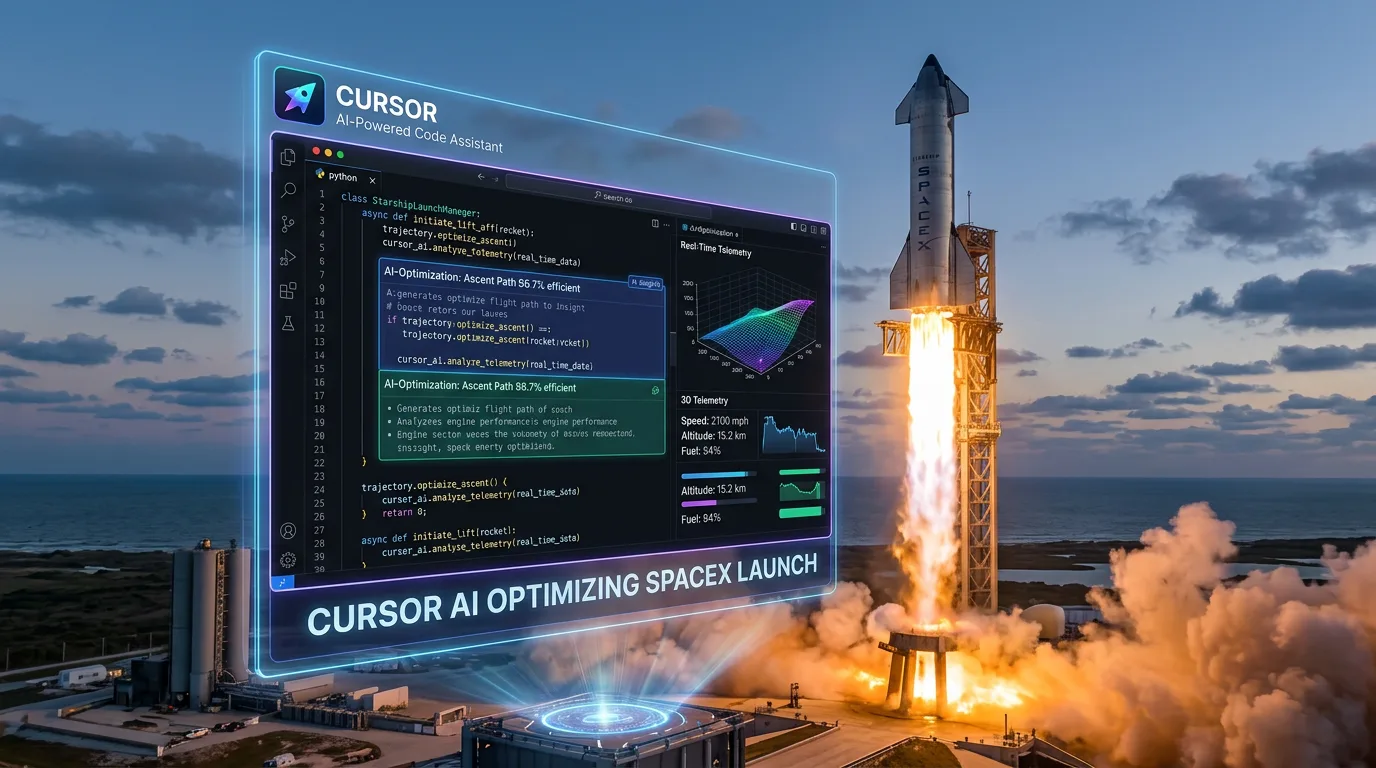
SpaceX's acquisition of Cursor — the real reason a space company jumped into the AI coding market
Contents
Elon Musk's SpaceX has secured an option to acquire AI coding startup Cursor for $60 billion. This is not a simple technology add-on but a strategic signal of a business realignment into a 'space + AI' conglomerate.
Background / why this topic now
On April 21, 2026, SpaceX announced via X (formerly Twitter) that it had signed a strategic partnership with AI coding startup Cursor. At its core are two options: acquire Cursor within the year for $60 billion (about 85–89 trillion won, based on TradingKey's analysis), or pay $10 billion (about 14–15 trillion won) for joint development. What stands out is that it is an 'option plus collaboration' structure rather than a firm acquisition.
The announcement came at the intersection of several timings. SpaceX is preparing the largest IPO in history for June 2026, with a target valuation of $1.75 trillion. It also came right after February's merger with Musk's AI startup xAI at a $1.25 trillion valuation. Securing the Cursor option extends the effort to redefine SpaceX from a 'rocket company' into a 'rocket + satellite + AI' conglomerate.
Interestingly, right up until the announcement, Cursor had been closing a $2 billion funding round at a $50 billion valuation led by Andreessen Horowitz (a16z), Nvidia, and Thrive Capital. SpaceX effectively preempted that round. Microsoft is also reported to have considered an acquisition but dropped its bid (CNBC, April 2026).
Key data and current state
- Deal size: $60 billion acquisition option / $10 billion partnership fee (Bloomberg, CNBC, April 2026)
- Cursor annual revenue forecast: Expected to exceed $6 billion by the end of 2026, about 5x the $1 billion at the end of 2025 (TradingKey, April 2026)
- Cursor enterprise adoption: In use at 64% of the Fortune 500 (Moneywise, April 2026)
- SpaceX IPO target: June 2026, valuation of $1.75–1.8 trillion (Yahoo Finance, April 2026)
- xAI merger: February 2026, valued at $1.25 trillion (CNBC, April 2026)
- Colossus supercomputer: Compute equivalent to 1 million Nvidia H100 GPUs (SpaceX official announcement)
Interpretation: Cursor is the fastest-growing company among AI coding tools, and SpaceX is aiming for a valuation premium by adding an AI revenue story right before its IPO. Wall Street assigns far higher valuation multiples to AI companies than to aerospace companies.
In-depth analysis
1. Why Cursor — compensating for xAI's (Grok's) weakness
Musk has publicly acknowledged that xAI lags competitors (Anthropic, OpenAI) in coding tools. According to a March 2026 analysis by forecaster Peter Wildeford, xAI was about seven months behind the top tier (Anthropic, Google, OpenAI).
xAI's AI chatbot 'Grok' is a general-purpose model that draws on real-time data from the X platform, but the prevailing assessment was that satisfaction with it in precision tasks such as coding and financial modeling was lower than with competing models (Anthropic's Claude and others). On top of that, all 11 co-founders of xAI had left. Departures accelerated after the February 2026 SpaceX merger, and with the last two (Manuel Kroiss and Ross Nordeen) leaving at the end of March, only Musk remained (confirmed by multiple outlets including TechCrunch, The Next Web, and Fortune, March 2026).
In this situation, Cursor provides two key assets. First, a proven product and enterprise customer base already in use at 64% of the Fortune 500. Second, a founding team regarded in Silicon Valley as top talent in the 'AI + compiler' field. These are assets xAI would find hard to build on its own in a short time.
2. The strategic meaning of the deal structure — exploiting IPO timing
The structure of the deal is unusual because it is directly tied to the IPO. SpaceX is analyzed to be deliberately deferring the acquisition until after the IPO, for two reasons.
First, it avoids the burden of having to resubmit confidential financial documents in the event of a firm acquisition.
Second, after the IPO it can pay the $60 billion purchase price in listed stock, greatly reducing the cash burden. The $10 billion partnership fee effectively serves as a 'breakup fee', giving SpaceX the flexibility to make the final decision based on market conditions.
From an investor's perspective, the deal is a device to get SpaceX re-rated as an AI company rather than a plain aerospace company. The difference between an aerospace company's valuation multiple and an AI company's can amount to hundreds of billions of dollars in market capitalization.
3. Realignment of the AI coding market
The deal kicks off the 'vertical integration race' in the AI coding tool market in earnest. The current market lineup is as follows.
SpaceX–xAI camp: Cursor (IDE) + Colossus (compute) + Grok (model) → aiming for full-stack vertical integration
Microsoft camp: GitHub Copilot (4.7 million paid subscribers) + Azure (cloud) + OpenAI partnership
Anthropic camp: Expanding the Claude Code service → annualized revenue passed $30 billion as of May 2026
OpenAI camp: Codex (4 million active users) + strengthening its own coding models
If Cursor is folded into SpaceX, its existing 'model neutrality' is likely to be compromised. Cursor currently supports multiple AI models, but after an acquisition it could be reorganized around xAI's Grok models. That creates uncertainty for existing Cursor users and gives competitors an opening to target defecting demand.
In particular, given the precedent of Anthropic immediately cutting off model access upon news of OpenAI's negotiations to acquire Windsurf, a similar ecosystem split could occur with Cursor.
Implications for Korea
The direct impact on the Korean market is limited, but there are a few things to watch.
First, as enterprise adoption of AI coding tools accelerates, it affects Korea's developer ecosystem too. Cursor already holds a significant share among Korean developers, and any change in model policy or pricing after the acquisition directly affects Korean users.
Second, if SpaceX's IPO goes through at a record size, whether Korean institutional investors (the National Pension Service, major asset managers, and others) participate is also of interest. The valuation debate over a new type of company, the space + AI conglomerate, is expected to take hold in Korea's investment industry as well.
Third, the trend toward vertical integration of AI infrastructure and software could indirectly affect GPU and HBM demand at Korean semiconductor companies such as Samsung Electronics and SK hynix. SpaceX–xAI's expansion of Colossus-class data centers suggests sustained demand for AI chips.
Outlook and variables to watch
- Scenario A (acquisition executed): If SpaceX acquires Cursor with stock after a successful IPO, the world's largest 'space + communications + AI' vertically integrated company is born. The AI coding market would be realigned immediately, and Cursor's model neutrality is likely to weaken.
- Scenario B (partnership only): Depending on market conditions or a valuation reassessment after the IPO, SpaceX could forgo the acquisition and pay only the $10 billion. Even then Cursor gains access to Colossus, but keeps independent management over the long term. Since the $10 billion is effectively a 'breakup fee', however, it is a substantial cost for SpaceX.
- Checkpoints: The outcome of SpaceX's June 2026 IPO and the stock's post-listing trajectory, how fast xAI rebuilds its technical capability after all co-founders left, the counterattack from Anthropic and OpenAI (strengthening Claude Code and Codex), and whether Cursor's existing enterprise customers defect
Conclusion
There are three key things to read from the SpaceX–Cursor deal.
First, Musk is stepping back from the 'AI model race' and shifting strategy toward controlling the 'infrastructure and environment in which AI operates'. Having acknowledged Grok's performance deficit, he chose a flanking strategy that combines the developer touchpoint (Cursor) with compute infrastructure (Colossus).
Second, the deal has a clear financial purpose: maximizing IPO valuation. It is an attempt to get the market to accept a $1.75 trillion valuation, hard to justify for a pure aerospace company, by adding an AI revenue story.
Third, the AI coding tool market is no longer a contest among independent startups but is turning into a vertical integration war among Big Tech. Developers should prepare for an era in which choosing a tool means choosing an ecosystem.
References
- Bloomberg (2026.4.21) — "SpaceX Has Deal for Right to Acquire Cursor for $60 Billion"
https://www.bloomberg.com/news/articles/2026-04-21/spacex-says-has-agreement-to-acquire-cursor-for-60-billion - CNBC (2026.4.21) — "SpaceX says it can buy Cursor later this year for $60 billion or pay $10 billion for 'our work together'"
https://www.cnbc.com/2026/04/21/spacex-says-it-can-buy-cursor-later-this-year-for-60-billion-or-pay-10-billion-for-our-work-together.html - CNBC (2026.4.22) — "Microsoft looked at buying Cursor before SpaceX deal, sources say"
https://www.cnbc.com/2026/04/22/microsoft-looked-at-buying-cursor-before-spacex-deal-sources-say.html - Yahoo Finance (2026.4.21) — "SpaceX strikes $60 billion deal for the right to buy AI coding startup Cursor"
https://finance.yahoo.com/markets/article/spacex-strikes-60-billion-deal-for-the-right-to-buy-ai-coding-startup-cursor-143350832.html - Futurum Group (est. 2026.4) — "Why the SpaceX-Cursor Deal Works for Both — and What It Means for Google, AWS, IBM"
https://futurumgroup.com/insights/why-spacex-cursor-works-for-both-and-what-it-means-for-google-aws-ibm/ - The Motley Fool (2026.4.30) — "3 Key Takeaways From SpaceX's Potential $60 Billion Deal With Cursor Leading Up to Its IPO"
https://www.fool.com/investing/2026/04/30/3-key-takeaways-from-spacexs-potential-60-billion/ - TradingKey (est. 2026.4) — "SpaceX IPO: Musk Weighs $60 Billion Cursor Deal, and Can It Save xAI?"
https://www.tradingkey.com/analysis/stocks/us-stocks/261808564-spacex-ipo-elon-musk-cursor-60-billion-tradingkey - Innovation & Tech Today (est. 2026.4) — "SpaceX Moves to Secure AI Coding Powerhouse Cursor"
https://innotechtoday.com/spacex-moves-to-secure-ai-coding-powerhouse-cursor/ - Moneywise (est. 2026.4) — "SpaceX just cut a $60 billion deal with AI startup Cursor"
https://moneywise.com/news/top-stories/spacex-cursor-deal-michael-truell-mit-dropout-ceo - Dakota (est. 2026.4) — "Cursor Raises $2B at $50B Valuation: AI Coding Goes Big"
https://www.dakota.com/resources/blog/cursor-raises-2-billion-at-50-billion-valuation-signaling-a-new-era-for-ai-developer-tooling - AI Matters (2026.4.22) — "SpaceX to take in AI coding startup Cursor… secures $60 billion acquisition option" (in Korean)
https://aimatters.co.kr/news-report/40854/ - AI Times (est. 2026.4) — "SpaceX partners with Cursor… could acquire it for 88 trillion won" (in Korean)
https://www.aitimes.com/news/articleView.html?idxno=209578 - Platum (est. 2026.4) — "Musk to take in AI coding tool Cursor for 89 trillion won" (in Korean)
https://platum.kr/archives/285720 - Economy Tribune (2026.4.22) — "SpaceX secures option to acquire coding AI 'Cursor'… strengthening strategy ahead of IPO" (in Korean)
https://www.economytribune.co.kr/news/articleView.html?idxno=3902379 - Korea Metaverse Journal (KMJ) (est. 2026.4) — "'Grok' shunned even internally… Musk's bid to seize AI infrastructure through the Cursor acquisition" (in Korean)
https://www.kmjournal.net/news/articleView.html?idxno=10658
Contents
Related posts
The real front line of the 2026 AI industry isn't models — the rise of the 'token economy' and a three-axis strategy for Korean companies
In 2026, the AI industry is no longer decided by 'which model is smarter'. The Anthropic–SpaceX compute deal, the Pentagon's selection of eight AI vendors, and Goldman Sachs' $7.6 trillion forecast all point one way: the true opening of an 'AI compute economy' in which tokens are the new currency. Korean companies must immediately realign around a three-axis strategy that binds 'token cost, power and chip supply, and use policy', beyond comparing model performance.

AI and the future of human relationships and mental health
A clinical trial found an AI chatbot cut depressive symptoms nearly in half, while a study found that the more people rely on AI friends, the lonelier they get, and both landed at the same time. Whether AI becomes a treatment for the mind or a substitute for relationships that deepens isolation: we are at that fork now.

The AI data center power problem — 'electricity hog' or engine of the green transition? (2026 Utopia vs. Dystopia ⑥)
The GPU drought is over, and the contest is now decided by power. In 2026, the approval rate for data center grid connections in Korea's capital region fell to 1.9%, and in the US a $130 billion project was canceled 'for lack of power'. Is AI devouring the climate, or bringing the energy transition forward? This installment examines both faces with data.
The EU AI Act in August 2026, what really changes — the real-time/retrospective facial recognition boundary and the shock of the 'Digital Omnibus'
August 2, 2026 has been billed for more than a year as the EU AI Act's most important date. But in November 2025 the European Commission unveiled its 'Digital Omnibus' package proposing to delay high-risk AI obligations by up to 16 months, and on May 7, 2026 the European Parliament and Council reached a provisional agreement. The result is more than a schedule change. The ban on real-time facial recognition survived, but retrospective facial recognition and workplace and education AI obligations are pushed beyond December 2027. Here is how the 'world's first AI regulation' wobbled, and what remained intact.