
The AI revolution: are jobs disappearing or being created? — a 2026 labor market analysis and Korea's crossroads
Contents
The AI revolution: are jobs disappearing or being created? — a 2026 labor market analysis and Korea's crossroads
Global statistics point to a net gain of 78 million jobs by 2030, yet the Bank of Korea reports that 210,000 youth jobs vanished in the three years after ChatGPT launched. Here is why opposite conclusions come from the same phenomenon, and why even I, in my mid-40s, am not free of this problem.
Background / why this topic now
In May 2025, Dario Amodei, CEO of AI company Anthropic, warned that 'AI could wipe out half of entry-level white-collar jobs within five years'. The strongest warning came from someone building AI. A year on, data are accumulating that let us judge whether that warning was mere marketing or a real signal.
In Korea, the change already shows up in the numbers. In 2025, full-time entry-level job postings at large companies fell 43% year on year, and in IT and telecom by a striking 67%. The Bank of Korea found that 211,000 youth jobs evaporated in the three years after ChatGPT's launch. Yet in the same period, global data send the opposite message. The World Economic Forum (WEF) projects 92 million jobs lost and 170 million created by 2030, for a net gain of 78 million.
Looking at the same phenomenon, one side talks of 'historic job creation' and the other of 'the disappearance of the entry ladder'. This article lays out both sets of data and then considers what Korea, in its particular situation, needs to prepare for.
Key data and current state
Global
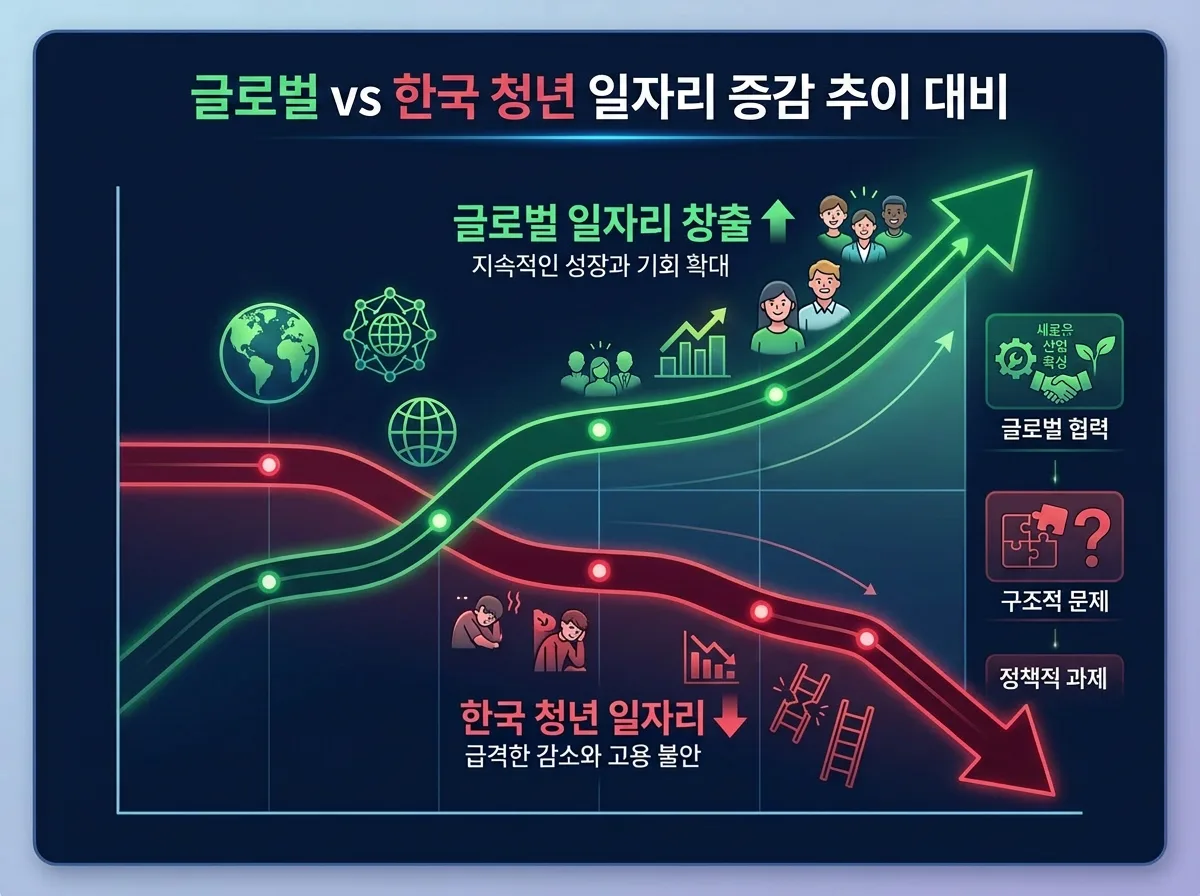
- Net job outlook: 92 million displaced / 170 million created / net gain of 78 million by 2030 (WEF Future of Jobs Report 2025)
- Range of displacement estimates: 6–7% of the US workforce temporarily displaced (Goldman Sachs, August 2025) to 50% of entry-level white-collar jobs gone within five years (Amodei, May 2025)
- Reskilling need: 40% of the global workforce will need new skills within three years (IBM Institute for Business Value)
- US layoffs directly attributed to AI: About 55,000 in 2025 (Challenger, Gray & Christmas)
- Big Tech entry-level hiring: Down about 50% from pre-pandemic levels (SignalFire)
- Cumulative IT layoffs as of April 2026: Passed about 92,000 (Layoffs.fyi)
Korea

- Increase in AI adoption rate: No. 1 in the world (+4.8 percentage points, Stanford HAI AI Index 2026)
- AI patent density: 14.31 per 100,000 people — No. 1 in the world (Stanford HAI 2026)
- Net inflow of AI talent: 35th of 38 OECD countries
- Youth jobs evaporated: 211,000 in the three years after ChatGPT's launch (Bank of Korea)
- Information services -23.8%, publishing -20.4%, computer programming -11.2%
- Full-time entry-level postings at large companies: 3,741 in 2024 → 2,145 in 2025 (-43%, Catch analysis, December 2025)
- IT and telecom -67%, construction and civil engineering -53%, sales and distribution -44%
- Experience levels large companies focus on hiring in 2026: 4–7 years 49.7%, entry level 12.4% (ZDNet, December 2025)
- People in their 20s 'just resting': 442,000 in January 2026 (highest since 2021)
- Time to land a first job: Average 8.8 months (longest since records began)
- Large companies using AI for HR: 86.7% of the top 500 companies by revenue (Ministry of Employment and Labor, Korea Employment Information Service, 2025)
? Interpretation: Global macro statistics say 'the total will grow', but Korea's micro data say 'entry-level workers and young people are taking the direct hit'. That both facts can be true at the same time is the essence of this problem.
In-depth analysis
The trap of the time lag — comfort in aggregates does not save the individual
The core argument of the optimists is simple: since the Industrial Revolution, every technology shock has ultimately created more jobs. The WEF's net 78 million and ITIF's analysis that 'AI job creation exceeded displacement through 2024' support this position. In its October 2025 report, the Yale Budget Lab concluded that widespread AI-driven unemployment had not yet occurred in the US labor market.
The problem is the time the transition takes. Even if enough new jobs are created in five or ten years, for someone who is 25, those five years are the decisive stretch of a life. If you can't land a first job, career capital never accumulates, and someone who starts at 30 can never quite catch up with someone who started at 22.
Amodei himself put his finger on exactly this. At Davos he said, 'AI does not hit one industry at a time. Because of its cognitive breadth, it affects finance, consulting, law, and tech simultaneously.' Whereas past technology shocks were confined to some areas so workers could move to others, AI shrinks the places to move to all at once.
Author's view: Past industrial revolutions had a clear direction, a shift to mass production and labor-intensive industries, which made new job creation possible. I still have doubts about how many new jobs will be created once AI and AGI are deployed across every industry. There is no guarantee anywhere that the proposition 'it has always been this way historically' holds this time too.
The disappearing entry ladder — a market without juniors, five years on
The clearest change on record is the collapse of entry-level hiring. In January 2026 the Yale Budget Lab named this 'the disappearing entry ladder'. The traditional career path, starting with simple tasks and gradually moving to complex ones, is collapsing as AI removes that first rung.
Korean data show this is already under way. When the Kyunghyang Shinmun data journalism team analyzed 7.88 million job postings from Employment24, obtained through Assemblyman Park Hong-bae's office, postings in 34 occupations with high AI replaceability fell 56.3% in three years, from 104,441 in 2022 to 45,675 in 2025. The share of experienced hires in SMB IT rose from 41.9% in 2019–2022 to 46.1% in 2023–2025, statistically confirming the narrowing of the entry path.
One unresolved question remains here.
Where will companies that stop hiring juniors find their seniors five years from now? Because seniors grow from juniors.
Companies that cut juniors for short-term efficiency are likely to face a talent gap in five years. And if every company makes the same decision at the same time, that gap becomes a crisis for the whole market.
Capital vs. labor — who gets the fruits of higher productivity?
Optimists say AI will shorten working hours and enable a more abundant life. Goldman Sachs estimates AI will raise labor productivity in the US and advanced economies by about 15%. By simple arithmetic, that means finishing the same work in less time or creating more value in the same time.
The problem is the distribution of those fruits. In a free-market capitalist system, there is no guarantee that corporate profits flow appropriately to workers. On the contrary, a KDI report found that in Korea AI adoption has little effect on whether people hold wage employment at all, but is estimated to reduce the average wages of women. While the average salary of an AI engineer, 85.74 million won, far exceeds the large-company average of 52.79 million won, the wages of women in clerical and service jobs are falling.
This polarization is a more sensitive issue in Korea. The productivity gap between large companies and SMBs is already wide, and gaps in access to training exist between the capital region and the rest of the country and between regular and non-regular workers. When AI is layered on top of these gaps, productivity differences translate directly into income gaps and gaps in job security. That the net inflow of 20–24-year-olds to the capital region hit +54,055 in 2025, the largest of any age group, is one facet of this gap.
Author's view: If the fruits of AI-driven productivity concentrate among owners of capital and do not flow to workers, consumer purchasing power ultimately shrinks, because workers are consumers. Does a society with worsening income inequality really help companies' profit-making? Even within the capitalist system, the answer is not clear. Without active state intervention, that is, a redistribution mechanism capitalism may dislike, if the labor market contracts sharply and new workers stop entering, can our society withstand that shock?
Implications for Korea
The demographic cliff and AI — complement or accelerator?
Korea carries a variable other countries do not. Due to low birth rates and aging, potential growth is projected to fall to the 0% range on average in 2031–2040 (Samil PwC). From this perspective, AI can be a tool to complement a shrinking workforce. Korea's world-leading robot density of 1,012 per 10,000 employees can be read in the same context.
Author's view: It would be fortunate if AI could replace scarce labor in Korea's peculiar demographic cliff, but that alone is not enough. In a structure where income inequality deepens at the same time, if the gap widens as the population shrinks, society as a whole could contract. This is where active state intervention is needed.
Dependence on global Big Tech and national AI infrastructure
AI development today is being driven not by nations but by global Big Tech companies. US companies such as OpenAI, Anthropic, Google, and Meta all but monopolize the core models, and Korean companies are closer to a structure of renting their APIs. Korea's five sovereign AI models (EXAONE, HyperCLOVA X, Solar Pro, A.X, NC AI) are concentrating on the 30B-parameter class and trying to differentiate on efficiency and Korean-language specialization, but in absolute scale they are small next to the 50 notable AI models of the US and 30 of China.
Author's view: In this structure, the gap in AI adoption looks set to widen further. If every company comes to depend on foreign Big Tech AI, the gap between large companies that can bear the cost and SMBs that cannot expands beyond a technology gap into a survival gap. I wonder whether we need, at the national level, an AI foundation model that every Korean company can use without depending on foreign Big Tech, a kind of public AI infrastructure.
The weak enforcement of the AI Basic Act — compromise or toothless?
Korea's AI Basic Act, passed by the National Assembly on December 26, 2024 (260 in favor of 264 present) and in force since January 22, 2026, is the world's second comprehensive AI regulation after the EU AI Act. But where the EU AI Act's maximum penalty is 35 million euros (about 49 billion won), Korea caps fines at 30 million won, a difference of more than 1,000 times. There are no criminal penalties, and a grace period of at least one year applies.
Author's view: I understand that it is hard to impose strong regulation before sufficient consensus and shared concern have formed among members of society. Personally, though, I believe a stronger AI Basic Act should go hand in hand with building national AI infrastructure. Strong regulation without infrastructure stifles industry; infrastructure without regulation worsens gaps and misuse. The two axes must move together.
Outlook and variables to watch
- Positive variable — the emergence of new occupations: Demand for new roles such as AI compliance specialists, AI ethics auditors, and AI impact assessment specialists is expected to grow more than 35% a year from 2026 to 2030 (Career Ahead Magazine, February 2026). The Korea Employment Information Service has confirmed the same trend.
- Risk variable — youth exiting the labor market: That the number of people in their 20s 'just resting' hit a record 442,000 in January 2026 means more than a statistic. Some are 'hidden unemployed' who do not appear in the official unemployment rate, having exited the labor market entirely.
- Checkpoint 1: Remarks on workforce cuts and the scale of AI infrastructure investment in US Big Tech quarterly earnings in 2026–2027. Alphabet, Microsoft, Meta, and Amazon plan to put about $700 billion into AI infrastructure in 2026 alone.
- Checkpoint 2: Follow-up measures to the Korean government's 'AI top three powers' policy and how the AI Basic Act is actually operated. Early 2027, when the one-year grace period ends, is the watershed.
- Checkpoint 3: Follow-up releases of Anthropic's Labor Market Impacts Report. Being based on actual usage data, it carries more value as a signal than theoretical estimates.
Conclusion
First, the data are a matter of reference. While the Yale Budget Lab sees 'negligible change', Anthropic reports a '14% slowdown among 22–25-year-olds'; Goldman estimates 2.5–7% while Amodei says 50%. The data you capture depend on the perspective and what you look at. The moment we believe there is a single right answer, we err.
Second, we must take seriously the possibility that this time is different. Past industrial revolutions had a clear path of labor migration (farm → factory → services), but AI hits the entire cognitive domain at once. Even if new jobs emerge, whether society can withstand the shock during the time needed to move is a separate question. There are people for whom five years is a lifetime, and I, in my mid-40s, am not free of it either. If longer life expectancy means living another 40 years, then the time spent holding on without adapting to the AI era becomes half a life.
Third, the role of the state matters more than ever. Market mechanisms alone cannot solve the distribution problem. Building public AI infrastructure, a strong AI Basic Act, investment in reskilling, and above all, to be covered in the next installment, a shift in the education paradigm must proceed together. If the education we received until now was education for labor (production), what kind of education should we give our children? I will continue this question in the next installment on 'education'.
[Source links]
Primary reports and research
- WEF Future of Jobs Report 2025
- Anthropic Labor Market Impacts Report (March 2026)
- Goldman Sachs: How Will AI Affect the Global Workforce? (August 2025)
- Brookings: Measuring US Workers' Capacity to Adapt to AI-Driven Job Displacement (February 2026)
- KDI: Labor market changes due to artificial intelligence and policy directions (March 2023)
- Samil PwC: AI and the Future of Jobs
- Stanford HAI AI Index 2026 — Korea analysis (summarized by Pebblous)
Major press coverage
- CNBC: 20,000 job cuts at Meta, Microsoft raise concern that AI-driven labor crisis is here (2026.04.24)
- CNBC: Anthropic CEO Dario Amodei warns AI may cause 'unusually painful' disruption to jobs (2026.01.27)
- Fortune: At Davos, CEOs said AI isn't coming for jobs as fast as Amodei thinks (2026.01.27)
- TheStreet: Anthropic CEO makes shocking admission about AI (2026.04.20)
- Hindustan Herald: Dario Amodei — AI Will Kill 50% of Entry-Level Jobs by 2031 (2026.04.23)
- Shawn Kanungo: Dario Amodei Was Right — AI Is Killing Entry-Level White-Collar Jobs (2026.04.21)
Korean coverage and data
- Kyunghyang Shinmun: AI swallowed SMB jobs… women and youth, the 'weak links' shaken first in the labor market (2026.04.24)
- ZDNet Korea: "No jobs to be had"… how far have full-time entry-level openings at large companies fallen (2025.12.24)
- ZDNet Korea: 2026 hiring trends… more '4–7 years' experience' and 'AI-capable talent' (2025.12.08)
- ZDNet Korea: Entry-level postings down, resting youth up… three 2026 hiring trends (2026.01.20)
- FKI: Survey of major companies' hiring plans for the second half of 2025
- Newspim: [Reading the economy through AI] ② The future of AI jobs in Korea (2026.04.23)
- Reportera: 210,000 youth jobs evaporate (2026.02.20)
- National HR News: 2026 AI regulation reaches a critical point (2026.03.02)
- Youth Union: The future of Korea's labor market as changed by AI (2026.04.26)
- 2026 second-half hiring trends roundup — Searchlight blog (April 2026)
Statistics roundups
Contents
Related posts
The AI data center power problem — 'electricity hog' or engine of the green transition? (2026 Utopia vs. Dystopia ⑥)
The GPU drought is over, and the contest is now decided by power. In 2026, the approval rate for data center grid connections in Korea's capital region fell to 1.9%, and in the US a $130 billion project was canceled 'for lack of power'. Is AI devouring the climate, or bringing the energy transition forward? This installment examines both faces with data.

The age of AI warfare: is a world where machines decide life and death a utopia? — the reality of a battlefield where drones became artillery
In March 2026, 96% of battlefield casualties in Ukraine were caused by drones. In April, for the first time in history, an enemy position was captured by unmanned platforms alone. The way war is fought is changing, but the suffering war brings is not. When the enemy comes with drones, will we fight with hand grenades? Thoughts from a citizen of a divided nation.

The real front line of the 2026 AI industry isn't models — the rise of the 'token economy' and a three-axis strategy for Korean companies
In 2026, the AI industry is no longer decided by 'which model is smarter'. The Anthropic–SpaceX compute deal, the Pentagon's selection of eight AI vendors, and Goldman Sachs' $7.6 trillion forecast all point one way: the true opening of an 'AI compute economy' in which tokens are the new currency. Korean companies must immediately realign around a three-axis strategy that binds 'token cost, power and chip supply, and use policy', beyond comparing model performance.

What should education teach in the AI era? — the 1.4 trillion won lesson and the conditions for a new Renaissance
While AI tutors raise learning outcomes by 23%, 70% of students feel their own thinking is getting weaker. Korea was the first in the world to pour 1.4 trillion won into AI digital textbooks, only to see the effort collapse within four months. The problem was not the technology. The problem was bringing in the tools before answering the question 'what should we teach?'