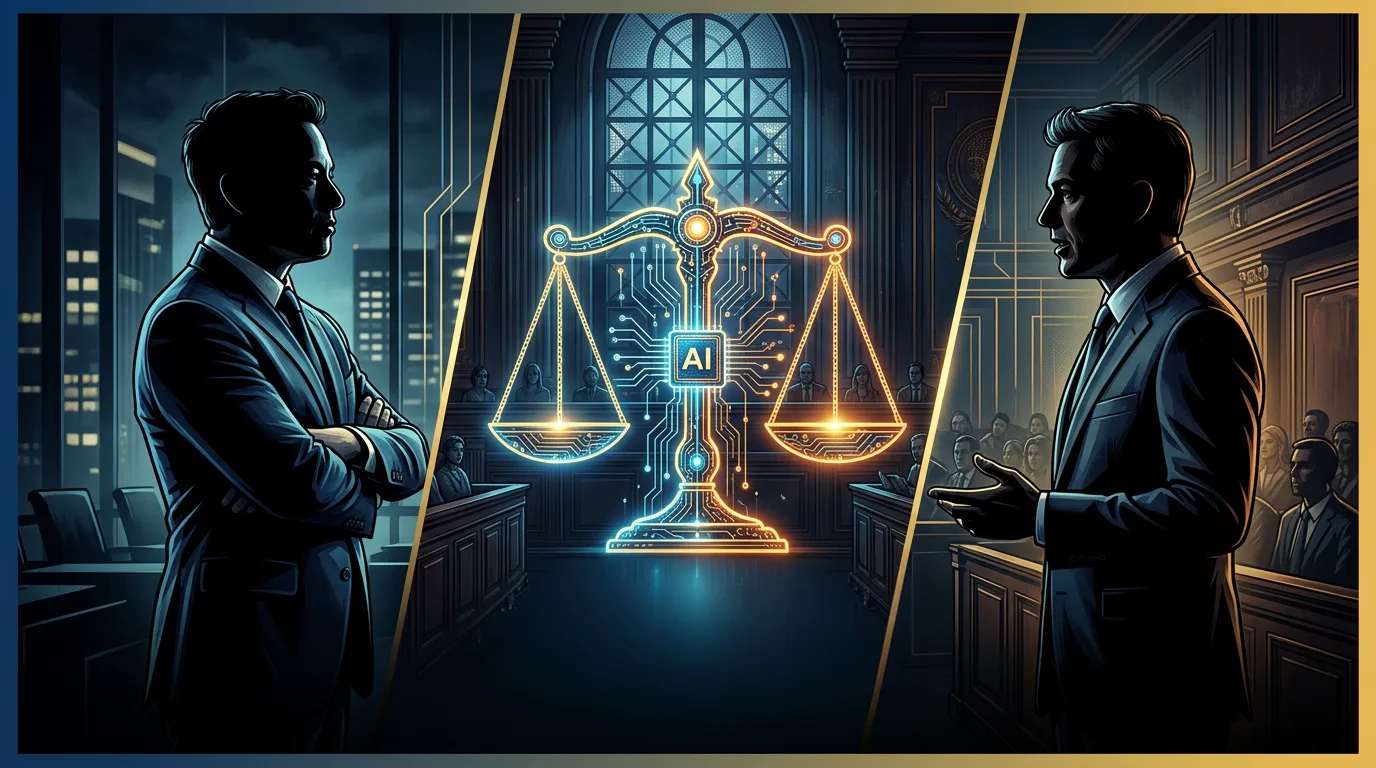
Musk vs. OpenAI, the trial of the century that could reshape the AI industry — a scenario-by-scenario analysis
Contents
Musk vs. OpenAI, the trial of the century that could reshape the AI industry — a scenario-by-scenario analysis
$134 billion in damages, the fate of a $1 trillion IPO, and the future of the nonprofit AI model are being decided in an Oakland courtroom. Now in its third week, we analyze the issues in the Musk v. Altman trial and the impact on the AI industry under each verdict scenario.
Background / why this topic now
The trial that began on April 27, 2026 in federal court in Oakland, California is no ordinary dispute between Silicon Valley founders. In this suit, the world's richest person, Elon Musk, seeks up to $134 billion in damages from OpenAI, which he co-founded, along with CEO Sam Altman, President Greg Brockman, and Microsoft. It is a historic case that could affect the capital structure, governance, and competitive order of the entire AI industry.
What makes the trial especially important is the timing. OpenAI is sounding out a valuation of about $1 trillion for an IPO targeted for Q4 2026, and Musk's xAI is preparing a June listing after merging with SpaceX, with a target valuation of $1.75 trillion. Roughly $3 trillion of combined IPOs could be affected by the ruling of a single court.
Key data and current state
- Trial period: April 27 to May 21, 2026 (about 3–4 weeks, in session Monday through Thursday)
- Remaining claims: Only 2 of the original 26 claims remain — ① breach of charitable trust, ② unjust enrichment
- Jury: 9-member advisory jury (advisory verdict to the judge; the final decision rests with Judge Yvonne Gonzalez Rogers)
- OpenAI's current valuation: Completed a $110 billion funding round in March 2026 at a valuation of about $852 billion (with Nvidia $30 billion, Amazon $50 billion, and SoftBank $30 billion participating)
- OpenAI annual revenue: About $25 billion (up more than 4x from $6 billion at the end of 2024)
- Musk's claim: Up to $134 billion (disgorgement of unjust enrichment, removal of executives, and reversion to the nonprofit structure)
Interpretation: The trial poses an unprecedented legal question: is using donations like investment capital to build an $850 billion company a breach of charitable trust? Depending on the outcome, the fundraising model of the AI industry itself could be shaken.
In-depth analysis
1. The core issues — what is being contested
Musk's central claim is clear: when he co-founded OpenAI in 2015, he donated $38 million on the promise of a 'nonprofit AI research lab for the benefit of humanity', and Altman and Brockman betrayed that promise by converting it into a for-profit company and enriching themselves.
In court, Musk described himself as 'a fool who provided free money to build an $800 billion company', and highlighted safety concerns by warning that AI could bring about a 'Terminator situation that could kill us all'. He also admitted in court that xAI 'partially distills' OpenAI's models, which caused a stir inside and outside the courtroom.
OpenAI counters that Musk in fact first argued for the for-profit conversion and wanted 'absolute control' over OpenAI. Brockman presented evidence that Musk had already pushed to set up a for-profit entity in 2017. OpenAI's counsel argues that 'Musk sued because he couldn't get his way at OpenAI'.
Today, May 12, in the third week, Microsoft CEO Satya Nadella took the stand and testified that Musk never directly raised concerns with him about Microsoft's investment. OpenAI co-founder Ilya Sutskever also appeared, testifying about the circumstances of Altman's brief ouster and expressing concern that the AI safety environment was threatened under Altman's leadership.
2. Impact on the AI industry under each verdict scenario
The outcome of the trial falls broadly into three scenarios, each with very different implications for the AI industry.
Scenario A: OpenAI wins (expected by most legal experts)
If OpenAI wins, the nonprofit-to-public-benefit-corporation (PBC) structure is legally validated. That creates the most favorable environment for OpenAI's Q4 IPO push and stabilizes the positions of major investors such as Microsoft and Nvidia. More broadly, it sets a precedent that mission-driven AI companies can raise large-scale capital while maintaining nonprofit governance.
Even with a complete victory, however, the internal conflicts exposed during the trial (Brockman's diary calling the 'nonprofit mission a lie', Murati's testimony that 'Altman fostered chaos', and so on) could remain a reputational risk.
Scenario B: Musk wins in part
If Musk is partially vindicated on breach of charitable trust, the court could impose limited conditions on OpenAI's governance. Even short of removing executives, it could strengthen the nonprofit foundation's oversight authority or impose additional constraints on for-profit activity. In that case OpenAI's IPO timeline is likely to slip, and investors would demand the results of a governance audit.
Scenario C: Musk wins outright (unlikely, but maximum impact)
If the court orders the for-profit structure dismantled, Altman and Brockman removed, and disgorgement in the billions to hundreds of billions of dollars, shockwaves would spread across the entire AI industry. OpenAI's IPO would be postponed indefinitely, and a revaluation of Microsoft's more than $27 billion investment would be unavoidable. The fundraising environment for AI labs with nonprofit origins (including companies with similar structures such as Anthropic) could fundamentally contract.
3. Structural effects on the AI competitive landscape
The trial's impact could extend beyond OpenAI and reshape the competitive terrain of the whole AI industry.
The future of the nonprofit-to-for-profit model: For AI organizations that, like OpenAI, started as nonprofits and run for-profit arms (Anthropic has a public benefit corporation structure), this ruling becomes a direct precedent. If Musk wins, future AI startups would either avoid the nonprofit structure from the outset or, conversely, have to build much stricter governance mechanisms from the earliest stage.
Shifts in investment capital flows: Global private AI investment reached $344.7 billion in 2025 (Stanford AI Index). Much of that capital is concentrated in 'hybrid structure' companies such as OpenAI and Anthropic. If the ruling shakes the legal stability of that structure, capital could move to purely for-profit companies or the in-house AI divisions of Big Tech.
The Musk–Altman 'dual IPO' race: Interestingly, both sides face mega IPOs. OpenAI is targeting a valuation of about $1 trillion in Q4, and xAI/SpaceX is pursuing a listing at $1.75 trillion around June. The outcome of the trial directly affects the narrative and valuation of both IPOs, and these two listings are set to be the biggest events in the global tech market in the second half of 2026.
Implications for Korea
The trial carries significant implications for Korea's AI industry as well.
First, governance models for AI companies. In Korea too, there are growing cases of AI startups that grew on government R&D subsidies or public-interest investment and then converted to for-profit operation. As moves like Upstage's acquisition of Daum, in which AI startups combine with large platforms, become more active, this trial shows that the relationship with early investors and donors can become a legal risk.
Second, indirect effects on AI investment sentiment. With the KOSPI having crossed 7,000 on the strength of AI and semiconductors, a ruling involving OpenAI that affects global AI investment sentiment could spill over indirectly to Korean AI-related stocks such as Samsung Electronics and SK hynix. With Nvidia having invested $30 billion in OpenAI, uncertainty over OpenAI's corporate structure also becomes a variable for Nvidia's stock and the Korean investors who trade it.
Third, the sustainability of the nonprofit AI research model . In Korea's AI research ecosystem, government-funded research institutes and nonprofit foundations also take part in AI development, and similar governance issues could arise as their research results are commercialized.
Outlook and variables to watch
- May 15–21 — end of Phase 1 (liability) and the advisory jury verdict: The jury delivers an advisory verdict on whether there was a breach of charitable trust. The judge has final authority, but the jury's opinion is a strong reference. With Altman's testimony scheduled from May 13, this week is set to be the highlight of the trial.
- After May 18 — the possibility of Phase 2 (remedies): If liability is found, the judge alone decides the remedies (removal of executives, dismantling the structure, disgorgement of funds, and so on). The jury does not take part in this stage.
- Ripple effects on the IPO schedule: Even if OpenAI wins, the governance issues exposed during the trial could resurface in the SEC review process. Conversely, a clean win would be a powerful driver for the Q4 IPO push.
- Interaction with the xAI/SpaceX listing: If Musk loses, xAI's competitive narrative (as the alternative to OpenAI) could weaken, but SpaceX's standalone value is so large that the effect on the listing itself is expected to be limited.
Conclusion
There are three key insights to take from this trial.
First, the capital structure of the AI industry has entered the stage of legal scrutiny. As the first case to contest whether a model that starts as a nonprofit and grows into a company worth hundreds of billions of dollars is legally valid, this ruling could become the AI industry's 'fundraising constitution'.
Second, the process is already changing the industry more than the outcome will. The internal documents, testimony, and emails made public are providing unprecedented transparency into AI company governance, founder relationships, and investor–management dynamics. These cases will become reference points when AI companies are founded in the future.
Third, whatever the result, AI competition accelerates. If OpenAI wins, an IPO strengthens its capital base; if Musk wins, opportunities open up for competitors such as xAI, Google, and Anthropic. The pace of AI progress is moving faster outside the courtroom, and this trial is an event that decides not 'who wins' but 'under what rules the competition is played'.
Contents
Related posts
The real front line of the 2026 AI industry isn't models — the rise of the 'token economy' and a three-axis strategy for Korean companies
In 2026, the AI industry is no longer decided by 'which model is smarter'. The Anthropic–SpaceX compute deal, the Pentagon's selection of eight AI vendors, and Goldman Sachs' $7.6 trillion forecast all point one way: the true opening of an 'AI compute economy' in which tokens are the new currency. Korean companies must immediately realign around a three-axis strategy that binds 'token cost, power and chip supply, and use policy', beyond comparing model performance.
SpaceX's acquisition of Cursor — the real reason a space company jumped into the AI coding market
Elon Musk's SpaceX has secured an option to acquire AI coding startup Cursor for $60 billion. This is not a simple technology add-on but a strategic signal of a business realignment into a 'space + AI' conglomerate.

AI and the future of human relationships and mental health
A clinical trial found an AI chatbot cut depressive symptoms nearly in half, while a study found that the more people rely on AI friends, the lonelier they get, and both landed at the same time. Whether AI becomes a treatment for the mind or a substitute for relationships that deepens isolation: we are at that fork now.
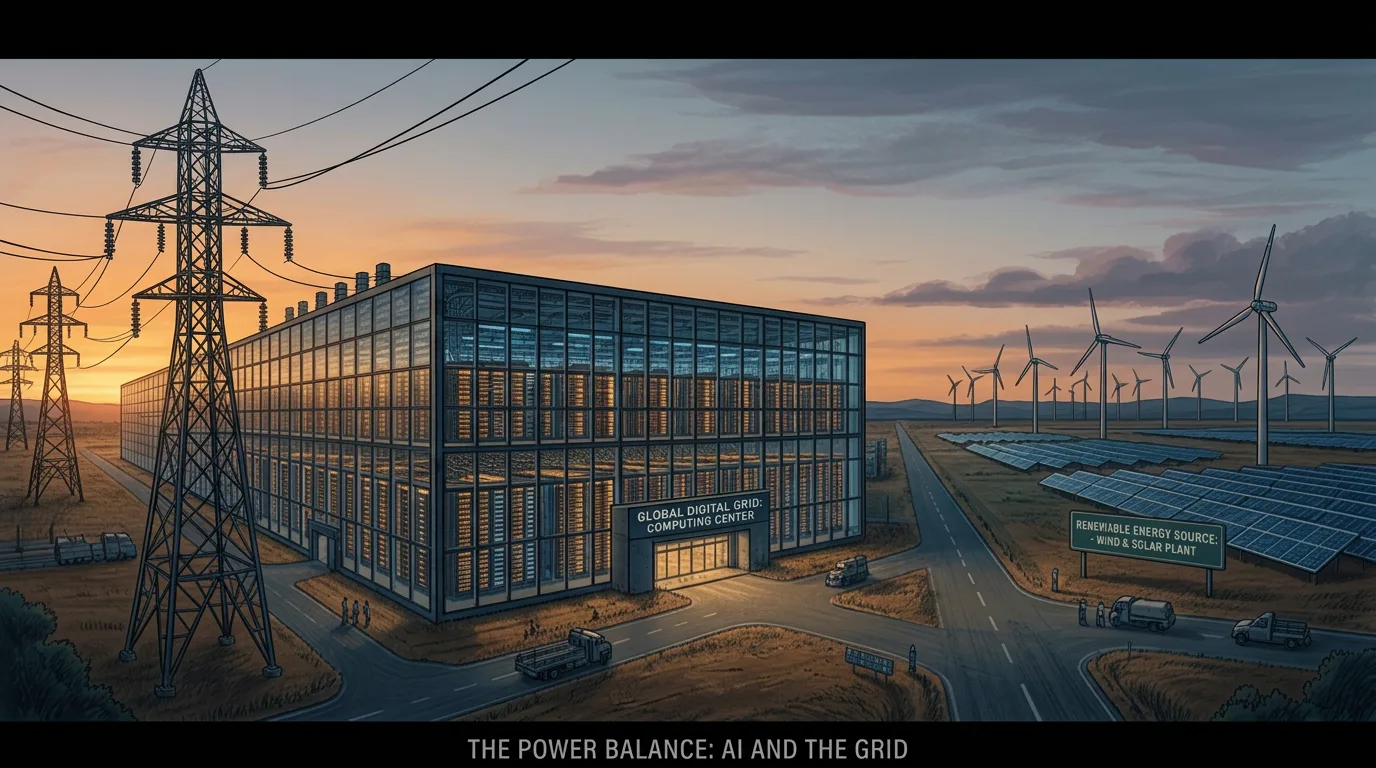
The AI data center power problem — 'electricity hog' or engine of the green transition? (2026 Utopia vs. Dystopia ⑥)
The GPU drought is over, and the contest is now decided by power. In 2026, the approval rate for data center grid connections in Korea's capital region fell to 1.9%, and in the US a $130 billion project was canceled 'for lack of power'. Is AI devouring the climate, or bringing the energy transition forward? This installment examines both faces with data.